Back

Practice - Nucleic Acids 3 definitions

Control buttons has been changed to "navigation" mode.
1/15
  • Adenosine

    A molecule formed by ribose linked to adenine, lacking a phosphate group, and classified as a nucleoside rather than a nucleotide.
  • Nucleoside

    A compound consisting of a sugar and a base, but missing a phosphate group, distinguishing it from a nucleotide.
  • Nucleotide

    A molecule composed of a sugar, a base, and at least one phosphate group, essential for forming nucleic acid polymers.
  • Phosphate Group

    A negatively charged chemical group attached to nucleotides, contributing to DNA's hydrophilic exterior and overall structure.
  • Base Stacking

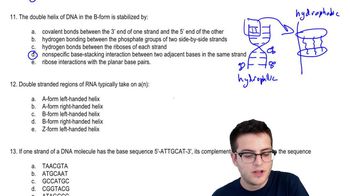
    Nonspecific interactions between adjacent bases in a nucleic acid strand, providing major stability to the double helix.
  • Hydrophobic Forces

    Interactions within the DNA helix that exclude water, mainly responsible for stabilizing base stacking between bases.
  • Hydrophilic Forces

    Interactions between water and the exterior of DNA, especially with phosphate groups, aiding in structural stability.
  • B Form

    The most common right-handed helical structure of DNA, characterized by its specific geometry and found in most cellular DNA.
  • A Form

    A right-handed helical structure adopted by double-stranded RNA, differing from DNA's typical conformation.
  • Z Form

    A left-handed helical structure of DNA, often present in regulatory sequences and distinct from A and B forms.
  • Complementary Strand

    A DNA or RNA sequence that pairs with another strand, always written from 5' to 3', ensuring accurate base pairing.
  • Denaturation

    The process where heating causes DNA strands to separate by breaking hydrogen bonds, while covalent bonds remain intact.
  • Hyperchromic Shift

    An increase in UV light absorbance observed when DNA denatures, indicating strand separation and loss of helical structure.
  • Dideoxynucleotide

    A modified nucleotide lacking a 3' hydroxyl group, used in sequencing to terminate DNA synthesis and generate fragments.
  • Sanger Sequencing

    A method for determining DNA sequence by using dideoxynucleotides to create fragments of varying lengths for analysis.