Back

Practice: Oxidative Phosphorylation 2 definitions

Control buttons has been changed to "navigation" mode.
1/14
  • Electron Transport

    Process in mitochondria moving electrons through membrane complexes, releasing protons into the intermembrane space.
  • Protonmotive Force

    Energy generated by proton gradient across the inner mitochondrial membrane, driving ATP synthesis.
  • ATP Synthase

    Enzyme complex utilizing protonmotive force to convert ADP and inorganic phosphate into ATP via conformational changes.
  • Intermembrane Space

    Region between inner and outer mitochondrial membranes where protons accumulate during electron transport.
  • Mitochondrial DNA

    Genetic material found in mitochondria, inherited exclusively from the mother, encoding a subset of mitochondrial proteins.
  • Nuclear Genes

    Genetic material in the cell nucleus responsible for encoding most mitochondrial proteins.
  • Ribosomes

    Cellular structures in mitochondria responsible for protein synthesis, produced by mitochondrial genome.
  • Transfer RNA

    Molecules in mitochondria facilitating translation of genetic code into proteins, synthesized by mitochondrial genome.
  • Uncouplers

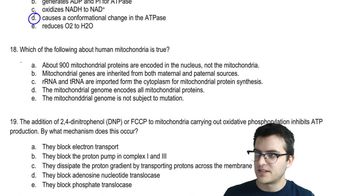
    Agents such as DNP and FCCP that disrupt the proton gradient, inhibiting ATP production while allowing electron transport.
  • DNP

    Chemical uncoupler dissipating the proton gradient in mitochondria, reducing ATP synthesis and lowering P/O ratio.
  • FCCP

    Ionophore uncoupler transporting protons across mitochondrial membrane, inhibiting ATP production.
  • Phosphate-to-Oxygen Ratio

    Measurement indicating the efficiency of ATP production relative to oxygen consumption in mitochondria.
  • Chemiosmotic Theory

    Concept describing the coupling of electron transport, proton gradient, and ATP synthesis in cellular energy metabolism.
  • Mutation

    Alteration in mitochondrial genes, potentially affecting protein synthesis and mitochondrial function.