Back

Practice: Oxidative Phosphorylation 3 quiz

Control buttons has been changed to "navigation" mode.
1/15
  • What reactive oxygen species are generated in mitochondrial electron transport?

    Superoxide radicals (O2-) are generated during mitochondrial electron transport.
  • Which enzyme converts superoxide radicals to hydrogen peroxide in the mitochondria?

    Superoxide dismutase converts superoxide radicals to hydrogen peroxide.
  • What enzyme converts hydrogen peroxide to water in the mitochondria?

    Glutathione peroxidase converts hydrogen peroxide to water.
  • What molecule does glutathione peroxidase use to convert hydrogen peroxide to water?

    Glutathione peroxidase uses glutathione to convert hydrogen peroxide to water.
  • How is glutathione regenerated after being oxidized by glutathione peroxidase?

    Glutathione is regenerated by reduction using NADPH.
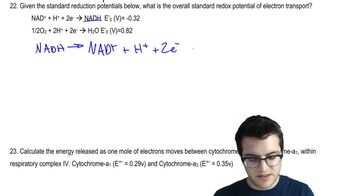
  • What is the overall standard redox potential of electron transport in mitochondria?

    The overall standard redox potential is approximately 1.14 volts.
  • Which molecule is the starting point for electron transport in mitochondria?

    NADH is the starting point for electron transport.
  • How do you calculate the overall redox potential for electron transport?

    Add the oxidation potential of NADH and the reduction potential of oxygen.
  • What equation is used to calculate the Gibbs free energy change for electron transfer?

    The equation is ΔG = −nFΔE.
  • What does 'n' represent in the equation ΔG = −nFΔE?

    'n' represents the number of moles of electrons transferred.
  • What is Faraday’s constant and its value in the context of electron transfer?

    Faraday’s constant is 96,500 joules per volt per mole.
  • Between which cytochromes is the electron transfer in complex IV calculated?

    The electron transfer is calculated between cytochrome a1 and a3.
  • What is the reduction potential difference used for calculating ΔG between cytochrome a1 and a3?

    The difference is 0.35 volts minus 0.29 volts.
  • What is the Gibbs free energy change for electron transfer between cytochrome a1 and a3?

    The Gibbs free energy change is −5,790 joules per mole or −5.79 kJ/mol.
  • Why is the energy released during electron transport important for ATP synthesis?

    The energy released drives ATP synthesis via the chemiosmotic theory.