Back

Protein Folding definitions

Control buttons has been changed to "navigation" mode.
1/15
  • Protein Folding

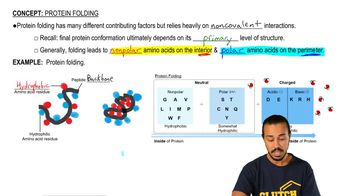
    Complex process where a polypeptide adopts a specific three-dimensional structure driven by non-covalent interactions.
  • Hydrophobic Effect

    Phenomenon causing non-polar amino acids to cluster inside proteins, minimizing contact with water.
  • Non-covalent Interactions

    Forces such as hydrogen bonds and van der Waals interactions that stabilize protein structure without forming chemical bonds.
  • Amino Acid Residue

    Individual building block within a polypeptide chain, influencing protein structure based on its properties.
  • Polypeptide Chain

    Linear sequence of amino acids linked by peptide bonds, forming the backbone of proteins.
  • Native Conformation

    Final, functional three-dimensional structure of a protein achieved after folding.
  • Hydrophobic Amino Acid

    Non-polar residue typically found in the protein's interior, avoiding water.
  • Hydrophilic Amino Acid

    Polar or charged residue usually located on the protein's surface, interacting with water.
  • Charged Amino Acid

    Residue with a positive or negative charge at physiological pH, favoring exposure to aqueous environments.
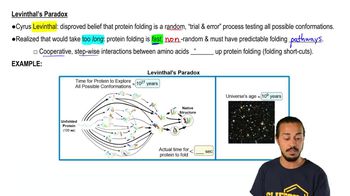
  • Leventhal's Paradox

    Concept highlighting that protein folding is not random but follows efficient, predictable pathways.
  • Folding Pathway

    Sequence of structural changes a protein undergoes to reach its native conformation.
  • Cooperative Interaction

    Mutual influence among amino acids that accelerates and guides protein folding.
  • Peptide Backbone

    Continuous chain of atoms in a protein formed by repeating peptide bonds, supporting side chains.
  • Physiological pH

    Environmental condition around pH 7.4, affecting amino acid charge and protein folding.
  • Aromatic Amino Acid

    Residue containing a ring structure, distributed among polar and non-polar groups in proteins.