Back

Quaternary Structure definitions

Control buttons has been changed to "navigation" mode.
1/15
  • Quaternary Structure

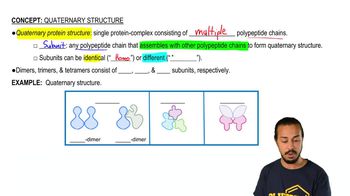
    Assembly of multiple polypeptide chains into a single protein complex, enabling cooperative interactions and functional diversity.
  • Subunit

    Individual polypeptide chain within a protein complex, capable of interacting with other chains to form higher-order structures.
  • Homomeric Complex

    Protein assembly composed of identical polypeptide chains, resulting in uniform subunit interactions.
  • Heteromeric Complex

    Protein assembly containing non-identical polypeptide chains, allowing for diverse functional properties.
  • Dimer

    Protein complex formed by two polypeptide chains, which may be identical or different in sequence.
  • Trimer

    Protein complex consisting of three polypeptide chains, enabling more intricate structural arrangements.
  • Tetramer

    Protein complex composed of four polypeptide chains, often exhibiting cooperative behavior among subunits.
  • Noncovalent Interaction

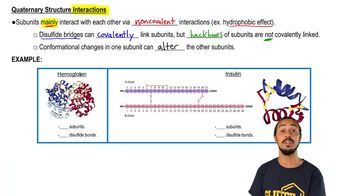
    Forces such as hydrophobic effect that stabilize protein complexes without forming permanent chemical bonds.
  • Hydrophobic Effect

    Driving force for subunit association, resulting from exclusion of water and clustering of nonpolar regions.
  • Disulfide Bridge

    Covalent linkage formed between cysteine residues, stabilizing protein structure and connecting subunits.
  • Cysteine Residue

    Amino acid with a thiol group, capable of forming disulfide bonds that influence protein stability.
  • Conformational Change

    Alteration in the three-dimensional shape of a subunit, which can affect neighboring subunits in a complex.
  • Protein Backbone

    Linear sequence of amino acids in a polypeptide, not involved in covalent linkage between subunits.
  • Hemoglobin

    Example of a heterotetrameric protein, with four distinct subunits interacting mainly via noncovalent forces.
  • Insulin

    Protein composed of two polypeptide chains linked by disulfide bridges, illustrating covalent subunit connections.