Back

Quaternary Structure quiz

Control buttons has been changed to "navigation" mode.
1/15
  • What is quaternary protein structure?

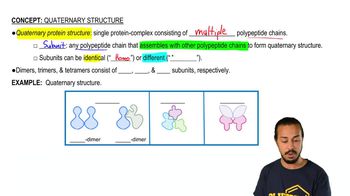
    Quaternary protein structure refers to a protein complex made up of multiple polypeptide chains, called subunits, assembled together.
  • What is a subunit in the context of quaternary structure?

    A subunit is any individual polypeptide chain that assembles with others to form a larger protein complex.
  • How do you distinguish between a homodimer and a heterodimer?

    A homodimer consists of two identical subunits, while a heterodimer consists of two different subunits.
  • What is a trimer in quaternary structure?

    A trimer is a protein complex composed of three subunits.
  • When is a protein complex called a heterotetramer?

    A protein complex is a heterotetramer if it has four subunits that are not all identical.
  • What types of interactions primarily hold subunits together in quaternary structure?

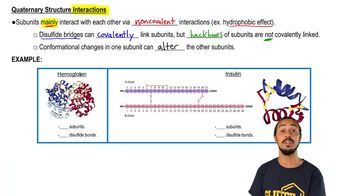
    Subunits are mainly held together by noncovalent interactions, such as the hydrophobic effect.
  • What is the exception to noncovalent interactions in quaternary structure?

    Disulfide bridges, which are covalent bonds between cysteine residues, can also link subunits together.
  • Do subunits in quaternary structure link via their backbones?

    No, subunits are not covalently linked via their backbones; they are connected through side chain interactions.
  • How can a conformational change in one subunit affect other subunits?

    A conformational change in one subunit can induce conformational changes in other subunits due to their close association.
  • What type of quaternary structure does hemoglobin have?

    Hemoglobin is a heterotetramer, meaning it has four non-identical subunits.
  • How are the subunits of hemoglobin held together?

    The subunits of hemoglobin are held together exclusively by noncovalent interactions, with no disulfide bonds between them.
  • How many subunits and disulfide bonds does insulin have?

    Insulin has two subunits and three disulfide bonds, two of which link the subunits together.
  • Where do the disulfide bridges in insulin form?

    Two disulfide bridges form between cysteine residues on different subunits, and one forms within the same subunit.
  • What is the significance of the hydrophobic effect in quaternary structure?

    The hydrophobic effect is a major noncovalent force that helps subunits associate in quaternary structure.
  • Why is understanding quaternary structure important for protein function?

    Quaternary structure is crucial because interactions and conformational changes between subunits can regulate protein function and allosteric modulation.