Back

Reducing Sugars Tests quiz

Control buttons has been changed to "navigation" mode.
1/15
  • What is a reducing sugar?

    A reducing sugar is a sugar with a free aldehyde or ketone group capable of being oxidized, such as aldoses with a free aldehyde group.
  • What color change indicates a positive Fehling's test for reducing sugars?

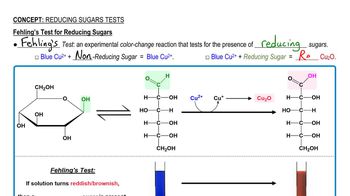
    A positive Fehling's test is indicated by a color change from blue to red due to the formation of red cupric oxide precipitate.
  • What is the oxidizing agent used in Fehling's and Benedict's tests?

    Both Fehling's and Benedict's tests use blue cupric ion (Cu²⁺) as the oxidizing agent.
  • What happens to the cupric ion in the presence of a reducing sugar during Fehling's test?

    The cupric ion is reduced, forming a red cupric oxide (Cu₂O) precipitate.
  • How can you distinguish between reducing and non-reducing sugars using Fehling's test?

    Reducing sugars cause the solution to turn red, while non-reducing sugars leave the solution blue with no precipitate.
  • What structural feature allows a sugar to be classified as reducing?

    A sugar is reducing if it has a free aldehyde group or a hemiacetal that can revert to the linear form with a free aldehyde.
  • How is Benedict's test similar to Fehling's test?

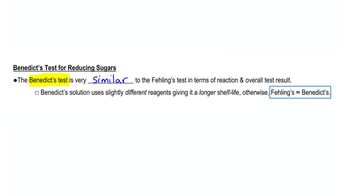
    Benedict's test is similar to Fehling's test in reaction mechanism and result, both showing a color change to indicate reducing sugars.
  • What is a practical advantage of Benedict's solution over Fehling's solution?

    Benedict's solution has a longer shelf life, making it more commonly used in labs.
  • What is the main result of a positive Benedict's test?

    A positive Benedict's test results in a color change from blue to red, indicating the presence of reducing sugars.
  • What oxidizing agent is used in Tollens' test?

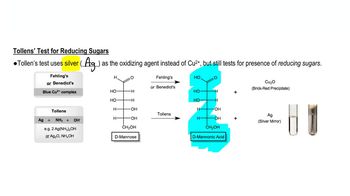
    Tollens' test uses silver ions (Ag⁺) as the oxidizing agent.
  • What visual result indicates a positive Tollens' test?

    A positive Tollens' test produces a silver mirror on the surface of the reaction vessel.
  • What happens to the reducing sugar during Tollens' test?

    The reducing sugar is oxidized to a carboxylic acid, while silver ions are reduced to metallic silver.
  • How do Fehling's and Benedict's tests detect reducing sugars?

    They detect reducing sugars by a color change resulting from the reduction of cupric ions to cupric oxide.
  • What is the negative control result in Fehling's or Benedict's test?

    The solution remains blue with no red precipitate, indicating no reducing sugars are present.
  • Why are reducing sugars important in biochemistry analysis?

    Reducing sugars are important because their ability to reduce metal ions is used to identify and analyze carbohydrates.