Back

Reducing Sugars definitions

Control buttons has been changed to "navigation" mode.
1/15
  • Reducing Sugar

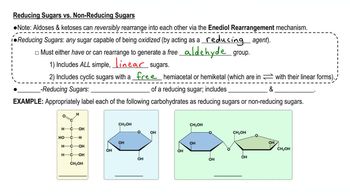
    A carbohydrate capable of being oxidized due to a free aldehyde group or the ability to generate one via rearrangement.
  • Non-Reducing Sugar

    A carbohydrate with full acetal or ketal groups, unable to be oxidized or act as a reducing agent.
  • Aldose

    A monosaccharide containing an aldehyde group, able to reversibly rearrange into a ketose.
  • Ketose

    A monosaccharide containing a ketone group, capable of rearranging into an aldose.
  • Hemiacetal

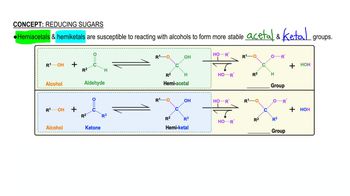
    An unstable structure formed from an alcohol and an aldehyde, featuring one OR group and one hydroxyl group.
  • Hemiketal

    An unstable structure formed from an alcohol and a ketone, featuring one OR group and one hydroxyl group.
  • Acetal

    A stable group with two OR groups branching from the same carbon, formed via dehydration synthesis from a hemiacetal.
  • Ketal

    A stable group with two OR groups branching from the same carbon, formed via dehydration synthesis from a hemiketal.
  • Anomeric Carbon

    The carbon atom in a sugar bonded to two oxygen atoms, crucial for identifying hemiacetal, hemiketal, acetal, or ketal groups.
  • Dehydration Synthesis

    A reaction where a water molecule is lost, converting hemiacetal or hemiketal into acetal or ketal.
  • Oxidation

    A chemical process where a sugar loses electrons, typically involving the conversion of a free aldehyde group.
  • Reducing Agent

    A substance that donates electrons in a reaction, becoming oxidized itself; in sugars, this role is linked to a free aldehyde group.
  • Monosaccharide

    A simple sugar molecule, either linear or cyclic, that can be classified as reducing or non-reducing based on its functional groups.
  • Disaccharide

    A carbohydrate formed by two monosaccharides linked covalently, often classified as non-reducing if both anomeric carbons are acetal or ketal.
  • Enediol Rearrangement

    A mechanism allowing aldoses and ketoses to reversibly convert into each other, impacting reducing sugar identification.