Back

Sequential (KNF) Model quiz

Control buttons has been changed to "navigation" mode.
1/15
  • What is another name for the sequential model in allosteric enzyme regulation?

    The sequential model is also known as the KNF model, named after the scientists who discovered it.
  • How do subunits transition from T to R state in the sequential model?

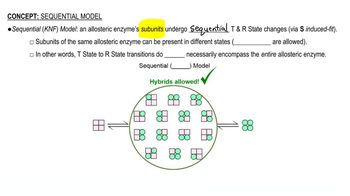
    Subunits transition from T to R state independently and sequentially, not simultaneously.
  • What induces the T to R state conversion in the sequential model?

    The conversion is induced by substrate binding, following the induced fit model.
  • Can hybrid states of T and R exist in the sequential model?

    Yes, hybrid states are allowed, meaning some subunits can be in T state while others are in R state.
  • How does the sequential model differ from the concerted model regarding subunit transitions?

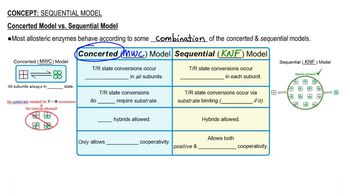
    Unlike the concerted model, which transitions all subunits simultaneously, the sequential model allows independent transitions.
  • What type of cooperativity does the sequential model support?

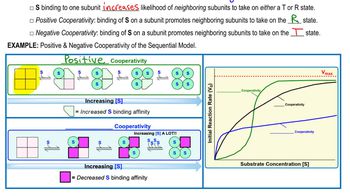
    The sequential model supports both positive and negative cooperativity.
  • What is positive cooperativity in the sequential model?

    Positive cooperativity occurs when substrate binding to one subunit promotes the R state in neighboring subunits, increasing their substrate affinity.
  • What is negative cooperativity in the sequential model?

    Negative cooperativity happens when substrate binding to one subunit promotes the T state in neighboring subunits, decreasing their substrate affinity.
  • How does negative cooperativity affect substrate binding in allosteric enzymes?

    It requires higher substrate concentrations for additional subunits to bind substrate efficiently.
  • Which model allows for both positive and negative cooperativity: concerted or sequential?

    Only the sequential model allows for both positive and negative cooperativity.
  • What is the effect of positive cooperativity on enzyme kinetics curves?

    Positive cooperativity produces sigmoidal kinetics, as seen in the green curve on enzyme plots.
  • What does the black curve represent in enzyme kinetics plots discussed in the lesson?

    The black curve represents no cooperativity, similar to Michaelis-Menten enzyme kinetics.
  • How does substrate binding affect neighboring subunits in negative cooperativity?

    It promotes neighboring subunits to remain in the T state, making substrate binding less efficient.
  • Are hybrids of T and R states allowed in the concerted model?

    No, hybrids are not allowed in the concerted model; all subunits are always in the same state.
  • Do most allosteric enzymes follow only one model (concerted or sequential)?

    No, most allosteric enzymes exhibit behaviors explained by a combination of both models.