Back

Specificity Constant quiz

Control buttons has been changed to "navigation" mode.
1/15
  • What is the specificity constant of an enzyme, and how is it calculated?

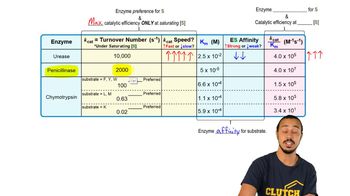
    The specificity constant is a measure of catalytic efficiency at low substrate concentrations and is calculated as the ratio of kcat to KM (kcat/KM).
  • Why is kcat alone not always the best measure of enzyme efficiency in cells?

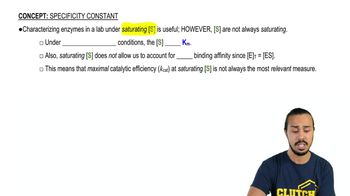
    Because kcat only reflects maximal efficiency under saturating substrate concentrations, which are not typical in physiological conditions.
  • What does a high specificity constant indicate about an enzyme's substrate preference?

    A high specificity constant indicates greater efficiency and a stronger preference for that substrate at low substrate concentrations.
  • How does the specificity constant relate to substrate concentration?

    The specificity constant is most relevant at non-saturating or low substrate concentrations, reflecting both catalytic speed and substrate binding affinity.
  • What does KM represent in enzyme kinetics?

    KM represents the substrate concentration at which the reaction rate is half-maximal and reflects the enzyme's binding affinity for its substrate.
  • How does the specificity constant differ from kcat in determining substrate preference?

    The specificity constant determines substrate preference at low substrate concentrations, while kcat determines preference at saturating concentrations.
  • What is the maximum value of the specificity constant, and what limits it?

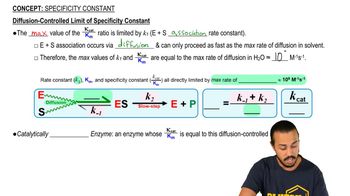
    The maximum value is about 10^9 M^-1s^-1, and it is limited by the rate of diffusion in water.
  • What is a catalytically perfect enzyme?

    A catalytically perfect enzyme has a specificity constant equal to the diffusion-controlled limit, meaning it converts substrate to product almost instantly upon binding.
  • Why can't enzyme binding affinity be assessed at saturating substrate concentrations?

    Because all enzyme molecules are bound to substrate regardless of affinity, so differences in binding strength are not observable.
  • How does chymotrypsin's specificity constant help explain its substrate selectivity?

    Chymotrypsin's specificity constant is higher for aromatic amino acids like phenylalanine, tyrosine, and tryptophan, indicating a preference for these substrates.
  • What does a low KM value indicate about an enzyme's affinity for its substrate?

    A low KM value indicates a strong binding affinity between the enzyme and its substrate.
  • How is the specificity constant affected by both kcat and KM?

    It increases with higher kcat (faster turnover) and lower KM (stronger affinity), reflecting overall catalytic efficiency.
  • What happens to the specificity constant if an enzyme has a high kcat but also a high KM?

    The specificity constant may not be high because the weak substrate affinity (high KM) offsets the fast turnover (high kcat).
  • Why is the specificity constant important for understanding enzyme behavior in vivo?

    Because substrate concentrations in cells are often near KM, making the specificity constant a more physiologically relevant measure of efficiency.
  • What physical process ultimately limits the maximum rate at which an enzyme can bind substrate?

    The maximum rate is limited by diffusion, specifically how quickly enzyme and substrate molecules can encounter each other in solution.