Back

Spectrophotometry definitions

Control buttons has been changed to "navigation" mode.
1/15
  • Spectrophotometry

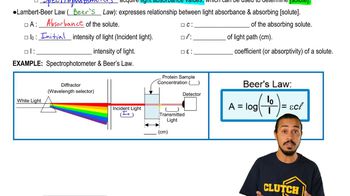
    Technique for quantifying molecules by measuring their light absorbance using specialized instruments.
  • Spectrophotometer

    Instrument that measures the intensity of light absorbed and transmitted through a sample.
  • Absorbance

    Value indicating how much light is absorbed by a sample, calculated from incident and transmitted light.
  • Beer’s Law

    Equation relating absorbance to concentration, path length, and extinction coefficient of a solute.
  • Incident Light

    Initial light directed at a sample before any absorption occurs, symbolized as I₀.
  • Transmitted Light

    Light that passes through a sample after absorption, symbolized as I.
  • Concentration

    Amount of solute present in a sample, influencing the degree of light absorption.
  • Path Length

    Distance light travels through a sample, typically measured in centimeters, affecting absorbance.
  • Extinction Coefficient

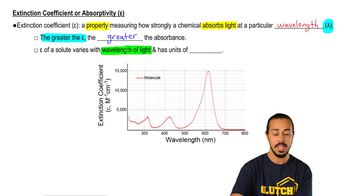
    Property indicating how strongly a molecule absorbs light at a specific wavelength, symbolized as ε.
  • Absorbance Spectrum

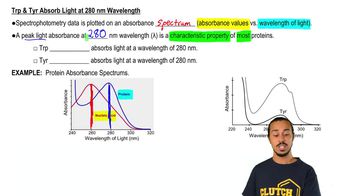
    Graph plotting absorbance values against wavelengths, revealing characteristic peaks for molecules.
  • Wavelength

    Specific distance between light wave peaks, critical for determining absorbance and extinction coefficient.
  • Tryptophan

    Amino acid responsible for strong protein absorbance at 280 nm, enabling protein quantification.
  • Tyrosine

    Amino acid contributing to protein absorbance at 280 nm, though less strongly than tryptophan.
  • Nucleic Acid

    Molecule type with characteristic absorbance peak at 260 nm, distinguishable from proteins.
  • Diffractor

    Component acting as a wavelength selector, splitting white light into its constituent wavelengths.