Back

Sphingoglycolipids quiz

Control buttons has been changed to "navigation" mode.
1/15
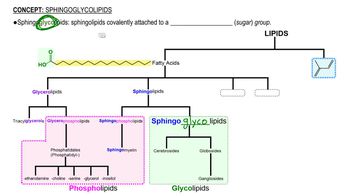
  • What distinguishes sphingoglycolipids from glycerolipids?

    Sphingoglycolipids are sphingolipids covalently linked to carbohydrate groups, while glycerolipids are based on a glycerol backbone.
  • What does the prefix 'glyco' indicate in sphingoglycolipids?

    'Glyco' indicates the presence of a carbohydrate or sugar group attached to the lipid.
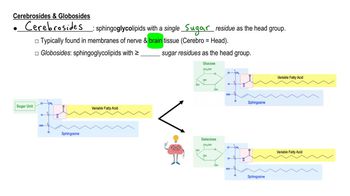
  • What is the main structural difference between cerebrosides and globosides?

    Cerebrosides contain a single sugar residue as the head group, while globosides have two or more sugar residues.
  • Where are cerebrosides most abundantly found in the body?

    Cerebrosides are abundant in the membranes of nerve and brain tissues.
  • What types of sugars are commonly found in cerebrosides?

    Cerebrosides commonly contain either glucose or galactose as their single sugar residue.
  • How many sugar residues are present in globosides?

    Globosides have two or more sugar residues as their head group.
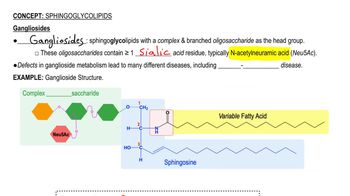
  • What is a defining feature of gangliosides compared to other sphingoglycolipids?

    Gangliosides have a branched oligosaccharide head group that includes at least one sialic acid residue.
  • What is the most common sialic acid residue found in gangliosides?

    The most common sialic acid residue in gangliosides is N-Acetylneuraminic acid (Neu5Ac).
  • What can defects in ganglioside metabolism lead to?

    Defects in ganglioside metabolism can cause neurodegenerative diseases such as Tay-Sachs disease.
  • What symptoms are associated with Tay-Sachs disease?

    Tay-Sachs disease can cause symptoms like blindness and can ultimately lead to death.
  • What is the basic structural component shared by all sphingoglycolipids?

    All sphingoglycolipids share a sphingolipid base with a carbohydrate head group.
  • Why is it important not to confuse the prefixes 'glyco' and 'glycero'?

    'Glyco' refers to carbohydrates or sugars, while 'glycero' refers to a glycerol molecule, which is a three-carbon backbone.
  • What type of head group does a cerebroside have?

    A cerebroside has a single sugar residue as its head group.
  • How does the structure of a globoside differ from a cerebroside?

    A globoside has two or more sugar residues, while a cerebroside has only one.
  • What is the significance of understanding sphingoglycolipids in biochemistry?

    Understanding sphingoglycolipids is crucial for grasping lipid diversity, membrane structure, and related metabolic disorders.