Back

Vmax Enzyme definitions

Control buttons has been changed to "navigation" mode.
1/15
  • Vmax

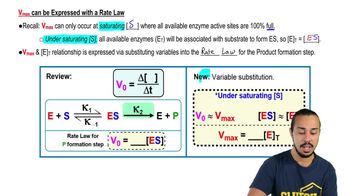
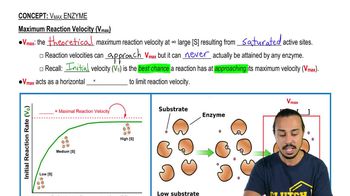
    Theoretical upper limit of reaction velocity for an enzyme, reached only at infinite substrate concentration when all active sites are saturated.
  • Active Site

    Region on an enzyme where substrate molecules bind, crucial for catalysis and determining reaction velocity.
  • Substrate Concentration

    Amount of substrate present in a reaction, influencing how close the reaction rate gets to its maximum velocity.
  • Enzyme Saturation

    Condition where all enzyme active sites are fully occupied by substrate, allowing the reaction to approach its maximum velocity.
  • Enzyme Kinetics Plot

    Graphical representation showing how reaction rate changes with substrate concentration, with Vmax as a horizontal asymptote.
  • Initial Velocity

    Reaction rate measured at the start of an enzyme-catalyzed reaction, best for estimating maximum velocity.
  • Enzyme-Substrate Complex

    Temporary molecular structure formed when substrate binds to enzyme, essential for product formation.
  • Total Enzyme Concentration

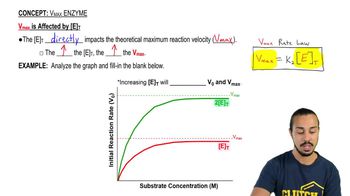
    Sum of all enzyme molecules present, directly affecting the maximum reaction velocity achievable.
  • Rate Law

    Mathematical expression relating reaction velocity to concentrations of reactants and rate constants, used to describe Vmax.
  • Rate Constant (k2)

    Specific value determining the speed of product formation from the enzyme-substrate complex, central to Vmax calculations.
  • Horizontal Asymptote

    Line on a kinetics plot representing the unattainable maximum reaction velocity, indicating saturation.
  • Product Formation Step

    Stage in enzyme catalysis where substrate is converted to product, governed by the rate constant k2.
  • Reaction Order

    Exponent in the rate law indicating how the reaction rate depends on reactant concentration, often assumed to be one for simple enzyme reactions.
  • Saturating Conditions

    Experimental setup with substrate levels high enough to ensure all enzyme molecules are bound, maximizing reaction velocity.
  • Enzyme Comparison

    Assessment of maximum velocities across different enzymes, requiring equal total enzyme concentrations for fairness.