Back

Vmax Enzyme quiz

Control buttons has been changed to "navigation" mode.
1/15
  • What is the definition of Vmax in enzyme kinetics?

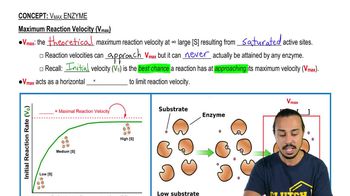
    Vmax is the theoretical maximum reaction velocity of an enzyme, occurring at infinitely large substrate concentrations where all enzyme active sites are saturated.
  • Why is Vmax considered a theoretical value?

    Vmax is theoretical because reaction velocities can only approach but never actually reach Vmax, as it requires infinite substrate concentration.
  • What does it mean for an enzyme to be saturated with substrate?

    Enzyme saturation means all available enzyme active sites are fully occupied by substrate molecules.
  • On an enzyme kinetics plot, what does the horizontal asymptote represent?

    The horizontal asymptote represents the Vmax, or the maximal reaction velocity, that the enzyme-catalyzed reaction can approach.
  • How does initial velocity (v0) relate to Vmax?

    Initial velocity (v0) is the best measure for approaching Vmax, especially at high substrate concentrations, but it never exceeds Vmax.
  • What happens to the initial reaction rate at low substrate concentrations?

    At low substrate concentrations, the initial reaction rate is low because most enzyme active sites are unoccupied.
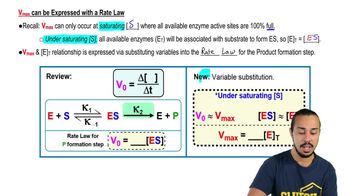
  • What is the relationship between total enzyme concentration and the enzyme-substrate complex at Vmax?

    At Vmax, the total enzyme concentration equals the concentration of the enzyme-substrate complex because all enzymes are bound to substrate.
  • How can Vmax be expressed using a rate law?

    Vmax can be expressed as the product of the rate constant for product formation (k2) and the total enzyme concentration (Et): Vmax = k2 × [Et].
  • Which rate constant is used in the rate law for Vmax?

    The rate constant used is k2, which is the rate constant for the product formation step.
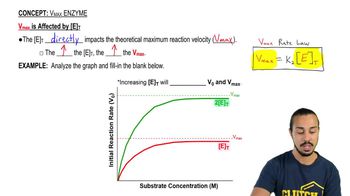
  • How does increasing total enzyme concentration affect Vmax?

    Increasing the total enzyme concentration increases Vmax proportionally, as more enzyme molecules can catalyze the reaction.
  • Why must total enzyme concentrations be considered when comparing Vmax values between reactions?

    Because Vmax depends on total enzyme concentration, comparisons are only fair if enzyme concentrations are the same.
  • What is the effect of substrate concentration on enzyme activity at medium levels?

    At medium substrate concentrations, some enzymes are occupied and some are not, resulting in a medium initial reaction rate.
  • What variable substitution is made in the rate law to express Vmax?

    The enzyme-substrate complex concentration is replaced with total enzyme concentration, and initial velocity (v0) is replaced with Vmax.
  • What does the enzyme kinetics curve look like as substrate concentration increases?

    The curve rises quickly at low substrate concentrations, then levels off and approaches a horizontal asymptote (Vmax) at high concentrations.
  • Why do biochemists focus on measuring initial velocity (v0) in enzyme kinetics?

    They focus on v0 because it reflects the reaction rate before substrate depletion or product inhibition, providing the best estimate for approaching Vmax.