Skip to main content
Calculus
My Course
Learn
Exam Prep
AI Tutor
Study Guides
Textbook Solutions
Flashcards
Explore
Try the app
My Course
Learn
Exam Prep
AI Tutor
Study Guides
Textbook Solutions
Flashcards
Explore
Try the app
Back
Applied Optimization definitions
You can tap to flip the card.
Applied Optimization
You can tap to flip the card.
👆
Applied Optimization
A process of maximizing or minimizing a real-world quantity by modeling it with a function and using calculus techniques.
Track progress
Control buttons has been changed to "navigation" mode.
1/15
Related flashcards
Related practice
Recommended videos
Applied Optimization quiz #1
Applied Optimization
10 Terms
Applied Optimization
5. Graphical Applications of Derivatives
4 problems
Topic
Ernest
Curve Sketching
5. Graphical Applications of Derivatives
3 problems
Topic
Justin
5. Graphical Applications of Derivatives
7 topics
13 problems
Chapter
Ernest
10:13
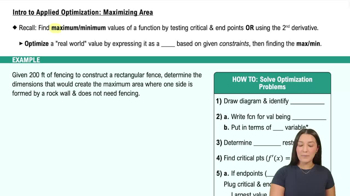
Intro to Applied Optimization: Maximizing Area
1884
views
47
rank
08:29
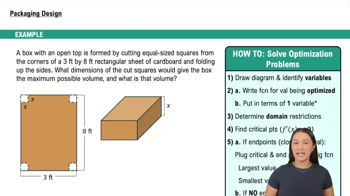
Example 5: Packaging Design
682
views
8
rank
13:49
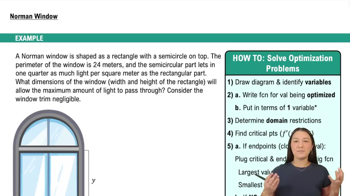
Example 4: Norman Window
718
views
5
rank
1
comments
Terms in this set (15)
Hide definitions
Applied Optimization
A process of maximizing or minimizing a real-world quantity by modeling it with a function and using calculus techniques.
Critical Point
A value where the first derivative of a function is zero, indicating a possible maximum or minimum.
Domain Restriction
A limitation on variable values based on real-world context, ensuring only feasible solutions are considered.
Extreme Value Theorem
A principle stating that a continuous function on a closed interval attains both a maximum and a minimum.
Second Derivative Test
A method using the sign of the second derivative at a critical point to determine if it is a maximum or minimum.
Revenue Function
An expression representing total income, typically as price per item times number of items sold.
Profit Function
An equation found by subtracting total costs from total revenue, representing net earnings.
Constraint
A condition or equation derived from the problem's context that limits possible solutions.
Closed Interval
A range of values including its endpoints, often used when real-world limits are present.
Open Interval
A range of values excluding its endpoints, requiring different methods to find extrema.
Perimeter Equation
A formula expressing the total length around a shape, often used as a constraint in geometry problems.
Area Function
An equation representing the size of a surface, typically in terms of one variable after applying constraints.
Price Demand Function
A relationship showing how price depends on the quantity sold, often used in revenue optimization.
Maximum Value
The largest output of a function within a given domain, found using calculus techniques.
Minimum Value
The smallest output of a function within a given domain, determined by evaluating endpoints and critical points.
 BackBack
 10:13
10:13