Skip to main content
Calculus
My Course
Learn
Exam Prep
AI Tutor
Study Guides
Textbook Solutions
Flashcards
Explore
Try the app
My Course
Learn
Exam Prep
AI Tutor
Study Guides
Textbook Solutions
Flashcards
Explore
Try the app
Back
Concavity definitions
You can tap to flip the card.
Concavity
You can tap to flip the card.
👆
Concavity
Describes the way a graph curves, indicating whether it bends upward like a smile or downward like a frown.
Track progress
Control buttons has been changed to "navigation" mode.
1/15
Related flashcards
Related practice
Recommended videos
Concavity quiz #1
Concavity
10 Terms
Concavity
5. Graphical Applications of Derivatives
3 problems
Topic
Jonathan
The Second Derivative Test
5. Graphical Applications of Derivatives
3 problems
Topic
Jonathan
5. Graphical Applications of Derivatives
7 topics
13 problems
Chapter
Ernest
02:33
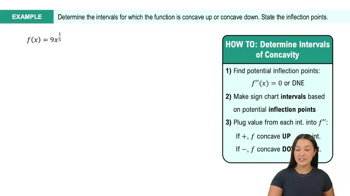
Determining Concavity Given a Function Example 3
731
views
14
rank
03:56
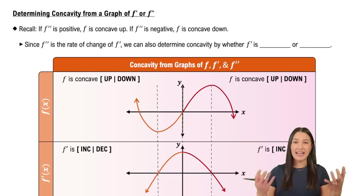
Determining Concavity from the Graph of f' or f''
952
views
17
rank
6:08
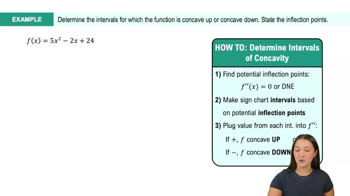
Determining Concavity Given A Function Example 2
816
views
15
rank
Terms in this set (15)
Hide definitions
Concavity
Describes the way a graph curves, indicating whether it bends upward like a smile or downward like a frown.
Second Derivative
Represents the rate of change of the slope, revealing how the slope itself increases or decreases.
Concave Up
A graph shape resembling a smile, where tangent lines lie below the curve and the second derivative is positive.
Concave Down
A graph shape resembling a frown, where tangent lines sit above the curve and the second derivative is negative.
Inflection Point
A location where the graph changes from concave up to concave down or vice versa, with the second derivative zero or undefined.
Tangent Line
A straight line touching a curve at one point, used to visualize slope and its changes on a graph.
Slope
A measure of steepness at a point on a graph, determined by the first derivative.
Sign Chart
A tool for organizing intervals and test values to determine where the second derivative is positive or negative.
Interval
A continuous range of x-values used to describe where a function is concave up or down.
Critical Point
A location where the first derivative is zero or undefined, often associated with local maxima or minima.
Power Rule
A differentiation shortcut for finding derivatives of terms with exponents, essential for computing higher derivatives.
Test Value
A chosen x-value within an interval, plugged into the second derivative to determine its sign.
Ordered Pair
A set of x and y values representing a specific point on a graph, such as an inflection point.
Rate of Change
A description of how a quantity varies with respect to another, with the second derivative showing changes in slope.
Derivative
A function describing the instantaneous rate of change, with the first derivative for slope and the second for concavity.
 BackBack
 02:33
02:33