Skip to main content
Calculus
My Course
Learn
Exam Prep
AI Tutor
Study Guides
Textbook Solutions
Flashcards
Explore
Try the app
My Course
Learn
Exam Prep
AI Tutor
Study Guides
Textbook Solutions
Flashcards
Explore
Try the app
Back
Differentiability definitions
You can tap to flip the card.
Continuity
You can tap to flip the card.
👆
Continuity
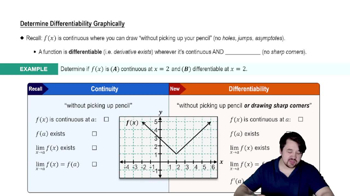
A property where a graph has no holes, jumps, or asymptotes, allowing it to be drawn without lifting a pencil.
Track progress
Control buttons has been changed to "navigation" mode.
1/15
Related flashcards
Related practice
Recommended videos
Differentiability quiz #1
Differentiability
10 Terms
Differentiability
2. Intro to Derivatives
3 problems
Topic
David-Paige
Basic Graphing of the Derivative
2. Intro to Derivatives
3 problems
Topic
Ally
2. Intro to Derivatives
4 topics
7 problems
Chapter
Jonathan
05:02
Determining Differentiability Graphically
2260
views
50
rank
05:20
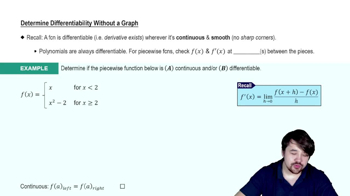
Determining Differentiability Without A Graph
1844
views
37
rank
Terms in this set (15)
Hide definitions
Continuity
A property where a graph has no holes, jumps, or asymptotes, allowing it to be drawn without lifting a pencil.
Differentiability
A condition where a function is both continuous and smooth, ensuring the derivative exists at all points.
Derivative
A measure of how a function changes as its input changes, representing the slope of the tangent line at a point.
Sharp Corner
A point on a graph where the direction changes abruptly, causing the tangent line to change suddenly.
Piecewise Function
A function defined by different expressions over different intervals, often requiring special checks at boundaries.
Limit
A value that a function approaches as the input approaches a certain point from either side.
Polynomial
An algebraic expression with terms consisting of variables raised to whole number powers, always continuous and differentiable.
Boundary Point
A value where two pieces of a piecewise function meet, often requiring checks for continuity and differentiability.
Tangent Line
A straight line that touches a curve at a single point, matching the curve's slope at that point.
Jump
A discontinuity where the graph suddenly moves from one value to another, breaking continuity.
Asymptote
A line that a graph approaches but never touches, indicating a type of discontinuity.
Smoothness
A quality of a graph where there are no abrupt changes in direction, ensuring differentiability.
Left-Hand Derivative
The slope of the tangent line as the input approaches a point from the left side.
Right-Hand Derivative
The slope of the tangent line as the input approaches a point from the right side.
Value of Interest
A specific input where continuity and differentiability are checked, often at boundaries in piecewise functions.
 BackBack
 05:02
05:02