Skip to main content
Calculus
My Course
Learn
Exam Prep
AI Tutor
Study Guides
Textbook Solutions
Flashcards
Explore
Try the app
My Course
Learn
Exam Prep
AI Tutor
Study Guides
Textbook Solutions
Flashcards
Explore
Try the app
Back
Exponential Functions definitions
You can tap to flip the card.
Exponential Function
You can tap to flip the card.
👆
Exponential Function
A mathematical rule where a constant positive base is raised to a variable exponent, producing rapid growth or decay.
Track progress
Control buttons has been changed to "navigation" mode.
1/15
Related flashcards
Related practice
Recommended videos
Exponential Functions quiz #1
Exponential Functions
10 Terms
Exponential Functions
0. Functions
3 problems
Topic
Ernest
Logarithmic Functions
0. Functions
4 problems
Topic
Ernest
0. Functions - Part 1 of 2
7 topics
14 problems
Chapter
Patrick
0. Functions - Part 2 of 2
8 topics
12 problems
Chapter
David-Paige
6:13
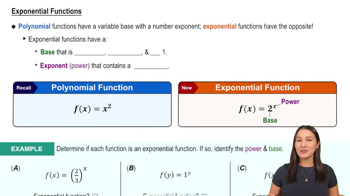
Exponential Functions
1486
views
20
rank
4:47
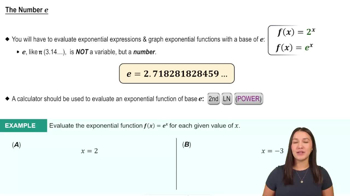
The Number e
1097
views
16
rank
5:46
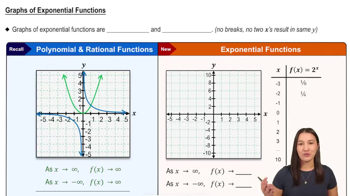
Graphs of Exponential Functions
1155
views
18
rank
Terms in this set (15)
Hide definitions
Exponential Function
A mathematical rule where a constant positive base is raised to a variable exponent, producing rapid growth or decay.
Base
A fixed positive number, not equal to 1, that is repeatedly multiplied in an exponential expression.
Exponent
A variable or expression in the power position, indicating how many times the base is used as a factor.
Continuous Graph
A curve with no breaks or gaps, representing all real input values for the function.
Horizontal Asymptote
A line that the graph approaches but never touches, often found at y = 0 for exponential decay.
Domain
The complete set of possible input values, typically all real numbers for exponential functions.
Range
The set of possible output values, usually all positive real numbers above the asymptote.
Growth
A pattern where function values increase rapidly as the exponent increases, seen when the base is greater than 1.
Decay
A pattern where function values decrease toward zero as the exponent increases, seen when the base is between 0 and 1.
e
An irrational constant approximately 2.718, arising from continuous compounding and natural processes.
Compounding Interest
A process where interest is calculated on both the initial amount and previously earned interest, leading to exponential growth.
Population Growth
A real-world application where quantities increase exponentially, often modeled using a base of e.
Fractional Base
A positive constant less than 1 used as the base, resulting in exponential decay.
Caret Key
A calculator symbol (^) used to indicate exponentiation when evaluating exponential expressions.
Transformation
A change applied to the basic graph, such as shifting or stretching, to create more complex exponential graphs.
 BackBack

 6:13
6:13