Skip to main content
Calculus
My Course
Learn
Exam Prep
AI Tutor
Study Guides
Textbook Solutions
Flashcards
Explore
Try the app
My Course
Learn
Exam Prep
AI Tutor
Study Guides
Textbook Solutions
Flashcards
Explore
Try the app
Back
Higher Order Derivatives definitions
You can tap to flip the card.
Higher Order Derivative
You can tap to flip the card.
👆
Higher Order Derivative
Result of applying differentiation repeatedly to a function, indicating rates of change beyond the first.
Track progress
Control buttons has been changed to "navigation" mode.
1/13
Related flashcards
Related practice
Recommended videos
Higher Order Derivatives quiz
Higher Order Derivatives
15 Terms
Higher Order Derivatives
3. Techniques of Differentiation
3 problems
Topic
Justin
Product and Quotient Rules
3. Techniques of Differentiation
4 problems
Topic
Justin
3. Techniques of Differentiation
5 topics
10 problems
Chapter
Ally
02:42
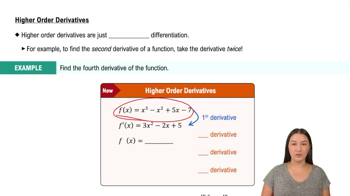
Higher Order Derivatives
1992
views
43
rank
1
comments
02:02
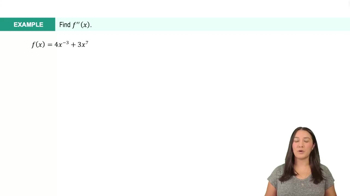
Higher Order Derivatives Example 1
1548
views
40
rank
1
comments
02:23
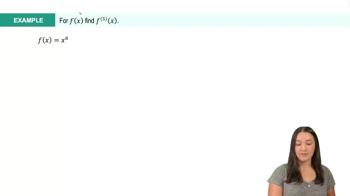
Higher Order Derivatives Example 2
1380
views
31
rank
Terms in this set (13)
Hide definitions
Higher Order Derivative
Result of applying differentiation repeatedly to a function, indicating rates of change beyond the first.
Second Derivative
Represents the rate of change of the rate of change, found by differentiating a function twice.
Third Derivative
Obtained by differentiating a function three times, often resulting in a constant for polynomials.
Fourth Derivative
Result of four successive differentiations, which for polynomials may yield zero.
Repeated Differentiation
Process of applying the differentiation operation multiple times to the same function.
Prime Notation
A symbolic method using one or more apostrophe-like marks to indicate the order of differentiation.
Parenthesis Notation
A notation style using a superscript number in parentheses to specify the order of the derivative.
Capital D Notation
A symbolic representation using a capital letter and a superscript to indicate the order of differentiation.
Power Rule
A differentiation technique where the exponent is multiplied by the coefficient and reduced by one.
Constant Function
A function whose derivative is zero, indicating no change regardless of input.
Order
The number of times differentiation is applied to a function, indicated by a superscript or prime marks.
Polynomial
An algebraic expression consisting of terms with non-negative integer exponents, often used in differentiation examples.
Notation
A system of symbols or marks used to represent derivatives and their respective orders.
 BackBack
 02:42
02:42