Skip to main content
Calculus
My Course
Learn
Exam Prep
AI Tutor
Study Guides
Textbook Solutions
Flashcards
Explore
Try the app
My Course
Learn
Exam Prep
AI Tutor
Study Guides
Textbook Solutions
Flashcards
Explore
Try the app
Back
Higher Order Derivatives quiz
You can tap to flip the card.
What is a higher order derivative?
You can tap to flip the card.
👆
What is a higher order derivative?
A higher order derivative is the result of differentiating a function more than once, such as the second or third derivative.
Track progress
Control buttons has been changed to "navigation" mode.
1/15
Related flashcards
Related practice
Recommended videos
Higher Order Derivatives definitions
Higher Order Derivatives
13 Terms
Higher Order Derivatives
3. Techniques of Differentiation
3 problems
Topic
Justin
Product and Quotient Rules
3. Techniques of Differentiation
4 problems
Topic
Justin
3. Techniques of Differentiation
5 topics
10 problems
Chapter
Ally
02:42
Higher Order Derivatives
1992
views
43
rank
1
comments
02:02
Higher Order Derivatives Example 1
1548
views
40
rank
1
comments
02:23
Higher Order Derivatives Example 2
1380
views
31
rank
Terms in this set (15)
Hide definitions
What is a higher order derivative?
A higher order derivative is the result of differentiating a function more than once, such as the second or third derivative.
How do you find the second derivative of a function?
You find the second derivative by differentiating the function twice in succession.
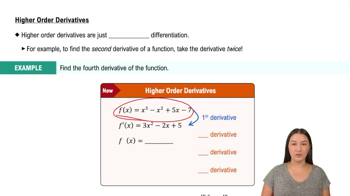
What is the second derivative of 3x² - 2x + 5?
The second derivative is 6, since differentiating twice gives f''(x) = 6.
What is the third derivative of 3x² - 2x + 5?
The third derivative is 0, because differentiating the constant 6 gives 0.
How is the second derivative commonly denoted?
It is commonly denoted as f''(x) using two prime marks.
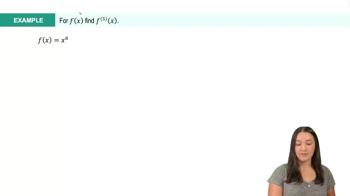
How can you denote the fourth derivative of a function?
You can denote it as f⁽⁴⁾(x), with a 4 in parentheses.
What is the derivative of a constant?
The derivative of a constant is always 0.
What does repeated differentiation mean?
Repeated differentiation means taking the derivative of a function multiple times in succession.
What is the result of differentiating 6x - 2?
Differentiating 6x - 2 gives 6.
What happens to the derivative as you continue differentiating a polynomial?
Eventually, you reach a constant, and further differentiation gives 0.
What is another notation for higher order derivatives besides prime marks?
Another notation is using a number in parentheses, such as f⁽ⁿ⁾(x), or using a capital D with n.
How many times do you differentiate to find the nth derivative?
You differentiate n times to find the nth derivative.
Is it common to find derivatives beyond the third or fourth order in practice?
No, practical applications usually do not require derivatives beyond a few orders.
What is the first step in finding a higher order derivative?
The first step is to find the first derivative of the function.
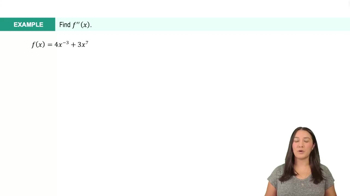
If f(x) = 3x² - 2x + 5, what is f'''(x)?
f'''(x) = 0, since the third derivative of the function is a constant.
 BackBack
 02:42
02:42