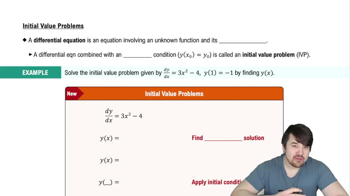
An initial value problem is a differential equation combined with an initial condition that specifies the value of the unknown function at a particular point.
What is a differential equation?
A differential equation is an equation involving an unknown function and its derivative.
How do you find the original function y(x) from its derivative in an initial value problem?
You integrate the derivative to obtain the original function y(x).
What is the purpose of the constant of integration 'c' in the general solution?
The constant 'c' accounts for all possible antiderivatives and is determined using the initial condition.
How do you use the initial condition to solve for the constant of integration?
You substitute the given x-value and y-value from the initial condition into the general solution and solve for 'c'.
What is the general solution to a differential equation?
The general solution is the result of integrating the differential equation, including the constant of integration 'c'.
What is the particular solution to an initial value problem?
The particular solution is the specific function y(x) found after determining the value of 'c' using the initial condition.
If given y'(x) = 3x^2 - 4 and y(1) = -1, what is the first step to solve for y(x)?
Integrate y'(x) to find the general solution for y(x).
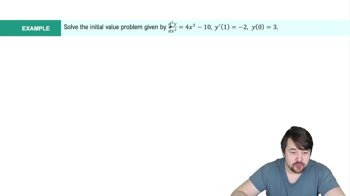
How do you handle initial value problems with higher-order derivatives?
Integrate repeatedly for each derivative, applying an initial condition for each integration.
Why can't you leave the solution as y(x) = x^3 - 4x + c in an initial value problem?
Because you need to use the initial condition to find the specific value of 'c' for the particular solution.
What does the initial condition y(1) = -1 represent?
It gives the value of the original function y(x) when x = 1.
What rule do you use to integrate terms like 3x^2 and -4 separately?
You use the sum and difference rule for integration.
If y'(x) = 3x^2 - 4, what is the integral of 3x^2?
The integral of 3x^2 is x^3.
After integrating and finding y(x) = x^3 - 4x + c, how do you solve for c using y(1) = -1?
Substitute x = 1 and y = -1 into the equation and solve for c.
What is the final solution for y(x) if y'(x) = 3x^2 - 4 and y(1) = -1?
 Back
Back
 05:59
05:59