Back

Integrals Involving Logarithmic Functions definitions

Control buttons has been changed to "navigation" mode.
1/15
  • Natural Logarithm

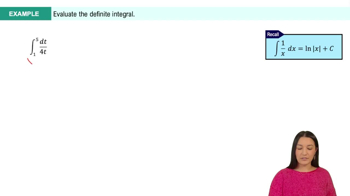
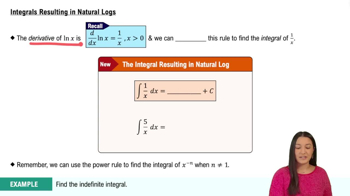
    A function whose derivative is one over its argument, often used as the antiderivative of one over x.
  • Absolute Value

    A notation used in integrals to ensure the result is defined for both positive and negative values of the variable.
  • Constant of Integration

    An arbitrary constant added to indefinite integrals to account for all possible antiderivatives.
  • Power Rule

    A method for integrating powers of a variable, except when the exponent is negative one.
  • Substitution

    A technique that simplifies integrals by replacing a complex expression with a single variable.
  • Rational Function

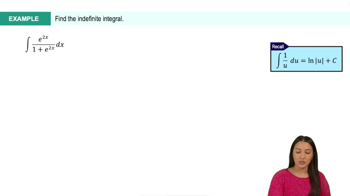
    An expression involving the ratio of two polynomials, often requiring substitution for integration.
  • Indefinite Integral

    An integral without specified limits, representing a family of antiderivatives.
  • Denominator

    The bottom part of a fraction, often chosen as the substitution variable in integration.
  • Antiderivative

    A function whose derivative yields the original integrand, found through integration.
  • Sum Rule

    A property allowing the integral of a sum to be written as the sum of individual integrals.
  • Negative Exponent

    A notation indicating reciprocal powers, useful for rewriting integrands before applying integration rules.
  • Polynomial

    An algebraic expression with terms of non-negative integer powers, often found in denominators requiring substitution.
  • Trig Function

    A function like secant or cosecant, whose integrals may involve logarithmic expressions after substitution.
  • Product Rule

    A differentiation rule needed when the substitution variable is a product, affecting the choice of substitution.
  • Logarithmic Integration

    A process where the result of integrating certain rational or trigonometric functions involves a natural logarithm.