Skip to main content
Calculus
My Course
Learn
Exam Prep
AI Tutor
Study Guides
Textbook Solutions
Flashcards
Explore
Try the app
My Course
Learn
Exam Prep
AI Tutor
Study Guides
Textbook Solutions
Flashcards
Explore
Try the app
Back
Introduction to Volume & Disk Method definitions
You can tap to flip the card.
Integral
You can tap to flip the card.
👆
Integral
A mathematical tool used to sum infinitely many small quantities, such as areas or volumes, across a continuous interval.
Track progress
Control buttons has been changed to "navigation" mode.
1/15
Related flashcards
Related practice
Recommended videos
Introduction to Volume & Disk Method quiz
Introduction to Volume & Disk Method
15 Terms
Introduction to Volume & Disk Method
9. Graphical Applications of Integrals
5 problems
Topic
Justin
Area Between Curves
9. Graphical Applications of Integrals
5 problems
Topic
Zachary
9. Graphical Applications of Integrals
2 topics
6 problems
Chapter
Justin
04:53
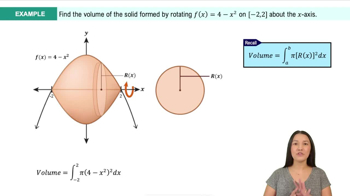
Finding Volume Using Disks Example 3
824
views
17
rank
02:27
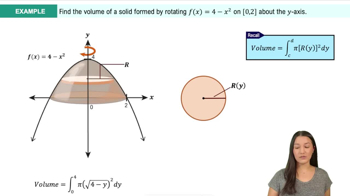
Disk Method Using y-Axis Example 5
526
views
18
rank
05:38
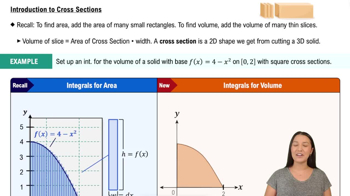
Introduction to Cross Sections
1806
views
50
rank
1
comments
Terms in this set (15)
Hide definitions
Integral
A mathematical tool used to sum infinitely many small quantities, such as areas or volumes, across a continuous interval.
Cross Section
A two-dimensional shape revealed by slicing through a three-dimensional solid perpendicular to a chosen axis.
Area Function
An expression representing the area of a cross section as a function of position, often used within an integral to find volume.
Solid of Revolution
A three-dimensional object generated by rotating a plane curve around a fixed axis.
Disk Method
A technique for finding volume by integrating the areas of circular cross sections perpendicular to the axis of revolution.
Radius Function
A formula describing the distance from the axis of revolution to the curve, used as the radius in circular cross sections.
Axis of Revolution
A fixed line around which a region or curve is rotated to create a three-dimensional solid.
Definite Integral
An integral evaluated over specific bounds, yielding a numerical value such as area or volume.
Bounds
The starting and ending values that define the interval over which an integral is calculated.
dx
A symbol representing an infinitesimal width along the x-axis, used as the variable of integration.
dy
A symbol representing an infinitesimal width along the y-axis, used as the variable of integration.
Function of x
An expression where the variable x determines the output, often used to describe the base or height in volume problems.
Function of y
An expression where the variable y determines the output, especially relevant when integrating with respect to y.
Interval
A continuous range of values, typically defining the domain over which integration occurs.
πr²
The formula for the area of a circle, used as the cross-sectional area in the disk method.
 BackBack
 04:53
04:53