Skip to main content
Calculus
My Course
Learn
Exam Prep
AI Tutor
Study Guides
Textbook Solutions
Flashcards
Explore
Try the app
My Course
Learn
Exam Prep
AI Tutor
Study Guides
Textbook Solutions
Flashcards
Explore
Try the app
Back
Introduction to Volume & Disk Method quiz
You can tap to flip the card.
What is the general approach to finding the volume of a three-dimensional solid using calculus?
You can tap to flip the card.
👆
What is the general approach to finding the volume of a three-dimensional solid using calculus?
We use integrals to sum the volumes of thin slices of the solid, each with a known cross-sectional area.
Track progress
Control buttons has been changed to "navigation" mode.
1/15
Related flashcards
Related practice
Recommended videos
Introduction to Volume & Disk Method definitions
Introduction to Volume & Disk Method
15 Terms
Introduction to Volume & Disk Method
9. Graphical Applications of Integrals
5 problems
Topic
Justin
Area Between Curves
9. Graphical Applications of Integrals
5 problems
Topic
Zachary
9. Graphical Applications of Integrals
2 topics
6 problems
Chapter
Justin
04:53
Finding Volume Using Disks Example 3
825
views
17
rank
02:27
Disk Method Using y-Axis Example 5
527
views
18
rank
05:38
Introduction to Cross Sections
1807
views
50
rank
1
comments
Terms in this set (15)
Hide definitions
What is the general approach to finding the volume of a three-dimensional solid using calculus?
We use integrals to sum the volumes of thin slices of the solid, each with a known cross-sectional area.
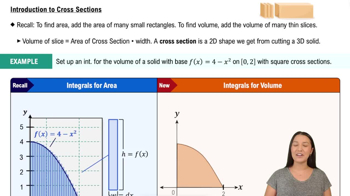
How do you find the area function for a solid with square cross sections?
The area function is the square of the function defining the base, so A(x) = [f(x)]².
What is a cross section in the context of finding volumes?
A cross section is a two-dimensional shape obtained by slicing into a three-dimensional solid.
How do you set up the volume integral for a solid with square cross sections?
Integrate the area function A(x) over the interval, so V = ∫[a to b] [f(x)]² dx.
What is the disk method used for?
The disk method is used to find the volume of solids of revolution with circular cross sections.
How is a solid of revolution formed?
It is formed by revolving a function around an axis, such as the x-axis or y-axis.
What is the area function for a circular cross section in the disk method?
The area function is π[r(x)]², where r(x) is the radius from the curve to the axis of revolution.
How do you determine the radius function r(x) when revolving around the x-axis?
The radius is the distance from the curve to the axis, so r(x) = f(x) minus the axis value (often y = 0).
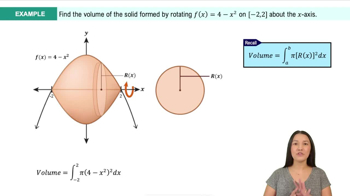
What is the volume integral for revolving f(x) = 4 - x² from x = -2 to x = 2 about the x-axis?
V = ∫[-2 to 2] π[4 - x²]² dx.
What changes when you revolve a function around the y-axis instead of the x-axis?
The radius function must be written in terms of y, and the integral is with respect to y.
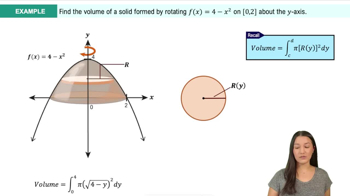
How do you rewrite f(x) = 4 - x² in terms of y for the disk method about the y-axis?
Solve for x: x = √(4 - y), which becomes the function g(y) for the radius.
What are the bounds for the volume integral when revolving f(x) = 4 - x² from x = 0 to x = 2 about the y-axis?
The bounds are y = 0 to y = 4, corresponding to the range of the function.
How do you set up the volume integral for revolving around the y-axis using the disk method?
V = ∫[0 to 4] π[√(4 - y)]² dy.
Why do the squared and square root cancel in the integral for the disk method about the y-axis?
Squaring the square root of (4 - y) gives (4 - y), simplifying the integrand.
What is the key step in setting up any volume integral using cross sections?
Identify the area function for the cross section and integrate it over the appropriate interval.
 BackBack
 04:53
04:53