Skip to main content
Calculus
My Course
Learn
Exam Prep
AI Tutor
Study Guides
Textbook Solutions
Flashcards
Explore
Try the app
My Course
Learn
Exam Prep
AI Tutor
Study Guides
Textbook Solutions
Flashcards
Explore
Try the app
Back
Inverse Trigonometric Functions definitions
You can tap to flip the card.
Inverse Trigonometric Function
You can tap to flip the card.
👆
Inverse Trigonometric Function
A mathematical tool that retrieves an angle from a given trigonometric value, always within a specific interval.
Track progress
Control buttons has been changed to "navigation" mode.
1/15
Related flashcards
Related practice
Recommended videos
Inverse Trigonometric Functions quiz
Inverse Trigonometric Functions
15 Terms
Inverse Trigonometric Functions
0. Functions
3 problems
Topic
Jonathan
Trigonometric Identities
0. Functions
2 problems
Topic
0. Functions - Part 1 of 2
7 topics
14 problems
Chapter
Patrick
0. Functions - Part 2 of 2
8 topics
12 problems
Chapter
David-Paige
1:58
Example 1
665
views
4
rank
3:17
Inverse Tangent
864
views
5
rank
4:49
Inverse Cosine
1333
views
14
rank
Terms in this set (15)
Hide definitions
Inverse Trigonometric Function
A mathematical tool that retrieves an angle from a given trigonometric value, always within a specific interval.
Inverse Sine
A function returning an angle between -π/2 and π/2 whose sine equals a given value between -1 and 1.
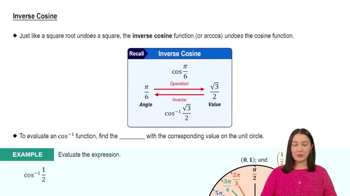
Inverse Cosine
A function yielding an angle between 0 and π whose cosine matches a given value from -1 to 1.
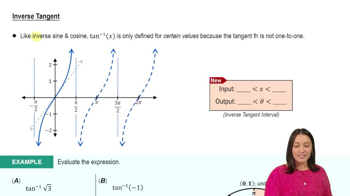
Inverse Tangent
A function producing an angle between -π/2 and π/2 whose tangent equals any real number.
Unit Circle
A circle of radius one centered at the origin, used to relate angles to trigonometric values.
Specified Interval
A restricted range of angles where an inverse trigonometric function provides valid outputs.
Composite Function
An expression where one function is nested inside another, requiring inside-out evaluation.
Vertical Line Test
A graphical method to determine if a curve represents a function by checking if any vertical line crosses it more than once.
One-to-One Function
A function where each output is paired with exactly one input, ensuring an inverse exists.
Undefined Value
A result that cannot be computed because the input falls outside the function's domain.
Principal Value
The unique angle returned by an inverse trigonometric function, always within its specified interval.
Reflection over y = x
A transformation used to derive the graph of an inverse function by swapping x and y coordinates.
Quadrant
A section of the coordinate plane, used to identify where angles and their trigonometric values lie.
Radian Mode
A calculator setting where angles are measured in radians, commonly used for trigonometric calculations.
Domain
The set of all possible input values for which a function is defined and produces real outputs.
 BackBack


 1:58
1:58