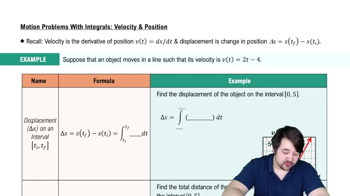
How do you find the displacement of an object given its velocity function over a time interval?
Integrate the velocity function over the given time interval; the result gives the change in position, or displacement.
What is the main difference between displacement and total distance traveled?
Displacement can be negative or positive depending on direction, while total distance is always positive and is found by integrating the absolute value of the velocity function.
How do you calculate the total distance traveled using a velocity function?
Integrate the absolute value of the velocity function over the specified interval to ensure all contributions are positive.
What does the area under the velocity-time curve represent?
It represents the displacement of the object over the given time interval.
How do you find the position function s(t) given an initial position and a velocity function?
Add the initial position to the integral of the velocity function from the initial time to t.
Why do we use a dummy variable (like x) when integrating to find the position function?
Using a dummy variable ensures the resulting function is in terms of the upper bound variable, typically t.
How do you find the position at a specific time once you have the position function?
Plug the specific time value into the position function and evaluate.
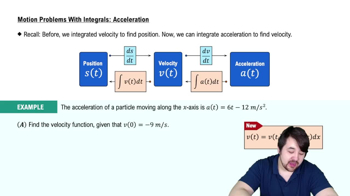
How are position, velocity, and acceleration related through calculus?
Velocity is the derivative of position, and acceleration is the derivative of velocity; conversely, integrating acceleration gives velocity, and integrating velocity gives position.
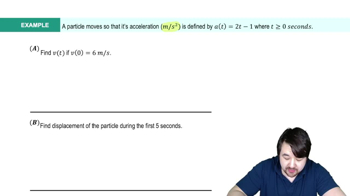
How do you find the velocity function given an acceleration function and initial velocity?
Add the initial velocity to the integral of the acceleration function from the initial time to t.
What is the process to find the position function if you are given the acceleration function and initial conditions?
First, integrate the acceleration function to get velocity, then integrate the velocity function to get position, adding initial values at each step.
What does integrating the acceleration function provide?
It provides the velocity function, up to an added constant determined by the initial velocity.
If a velocity function is negative over part of an interval, how does this affect displacement and total distance?
Negative velocity decreases displacement but, when calculating total distance, the negative part is made positive by taking the absolute value.
How do you handle intervals where the velocity function changes sign when calculating total distance?
Split the integral at the points where velocity is zero, integrate each part, and make negative results positive before summing.
What is the general formula for position given initial position s(0) and velocity v(t)?
s(t) = s(0) + ∫₀ᵗ v(x) dx, where x is a dummy variable of integration.
How do you find the future position of a particle at a given time using the position function?
Substitute the given time into the position function and compute the result.
 Back
Back
 10:17
10:17