Back

Logarithmic Differentiation definitions

Control buttons has been changed to "navigation" mode.
1/15
  • Logarithmic Differentiation

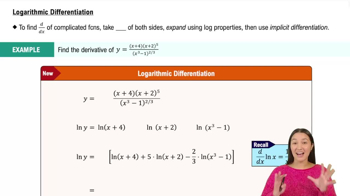
    A method using logarithms and implicit differentiation to simplify derivatives of complex expressions, especially with products, quotients, or variable exponents.
  • Natural Logarithm

    A logarithm with base e, often used to simplify differentiation by transforming multiplicative and exponential relationships.
  • Implicit Differentiation

    A technique for finding derivatives when variables are intertwined, requiring differentiation of both sides with respect to x.
  • Product Rule

    A differentiation rule for functions multiplied together, often replaced by logarithmic properties in this context.
  • Quotient Rule

    A differentiation rule for functions divided by each other, which can be avoided by expanding with logarithms.
  • Chain Rule

    A rule for differentiating composite functions, still needed when differentiating logarithms of functions of x.
  • Exponent Property

    A logarithmic property allowing exponents to be brought in front as multipliers, simplifying differentiation.
  • Logarithmic Expansion

    The process of rewriting logarithms of products, quotients, or powers as sums, differences, or multiples of simpler logs.
  • Variable Exponent

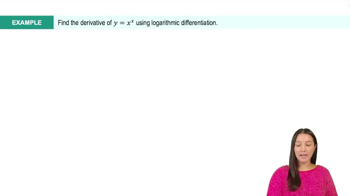
    An exponent that itself depends on a variable, such as in x to the x, requiring special differentiation techniques.
  • Derivative

    A measure of how a function changes as its input changes, often denoted as dy/dx.
  • Function Transformation

    The process of applying logarithms to both sides of an equation to facilitate easier differentiation.
  • Algebraic Simplification

    The reduction of complex expressions into simpler forms, often achieved after expanding logarithms.
  • Constant Multiple

    A number pulled out in front of a derivative or logarithm, simplifying calculations.
  • Numerator

    The top part of a fraction, which may contain products or powers that benefit from logarithmic expansion.
  • Denominator

    The bottom part of a fraction, whose differentiation can be simplified by logarithmic properties.