Back

Logarithmic Differentiation quiz

Control buttons has been changed to "navigation" mode.
1/15
  • What is the first step in logarithmic differentiation?

    Take the natural logarithm of both sides of the equation.
  • Why do we use logarithmic differentiation for complex functions?

    It simplifies the process by reducing the need for multiple differentiation rules like product, quotient, and chain rules.
  • How do you expand a logarithm of a product using log properties?

    The logarithm of a product becomes the sum of the logarithms of the individual factors.
  • What log property allows you to bring an exponent in a function down in front of the log?

    The property states that log(a^b) = b*log(a).
  • How do you handle a quotient inside a logarithm when expanding?

    The logarithm of a quotient becomes the difference of the logarithms: log(a/b) = log(a) - log(b).
  • What is the derivative of ln(y) with respect to x using implicit differentiation?

    It is (1/y) * dy/dx.
  • When differentiating ln(f(x)), what rule must you apply?

    You use the chain rule, resulting in (1/f(x)) * f'(x).
  • After differentiating both sides in logarithmic differentiation, what must you solve for?

    You solve for dy/dx, the derivative of the original function.
  • How do you eliminate the (1/y) factor after differentiating ln(y)?

    Multiply both sides of the equation by y.
  • What do you substitute for y after differentiating and solving for dy/dx?

    You substitute the original function for y.
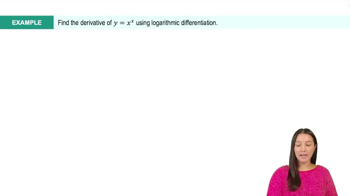
  • Why is logarithmic differentiation necessary for functions like x^x?

    Because traditional differentiation rules cannot be directly applied to such functions.
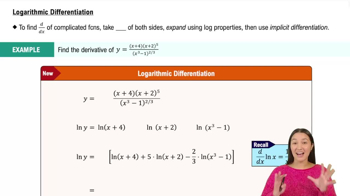
  • What is the derivative of ln(x+4) with respect to x?

    It is 1/(x+4).
  • How do you differentiate 5*ln(x+2) with respect to x?

    It becomes 5/(x+2).
  • What is the derivative of -2/3*ln(x^3-1) with respect to x?

    It is -2x^2/(x^3-1).
  • What are the three main steps in logarithmic differentiation?

    Take the natural log of both sides, expand using log properties, and use implicit differentiation to solve for dy/dx.