Skip to main content
Calculus
My Course
Learn
Exam Prep
AI Tutor
Study Guides
Textbook Solutions
Flashcards
Explore
Try the app
My Course
Learn
Exam Prep
AI Tutor
Study Guides
Textbook Solutions
Flashcards
Explore
Try the app
Back
Logarithmic Functions definitions
1 student found this helpful
You can tap to flip the card.
Logarithm
You can tap to flip the card.
👆
Logarithm
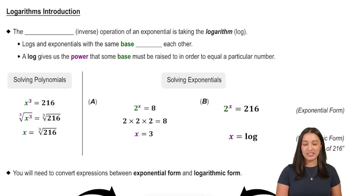
Inverse operation to exponentiation, revealing the power a base must be raised to for a given result.
Track progress
Control buttons has been changed to "navigation" mode.
1/14
Related flashcards
Related practice
Recommended videos
Logarithmic Functions quiz
Logarithmic Functions
15 Terms
Logarithmic Functions
0. Functions
4 problems
Topic
Ernest
Properties of Logarithms
0. Functions
4 problems
Topic
Ernest
0. Functions - Part 1 of 2
7 topics
14 problems
Chapter
Patrick
0. Functions - Part 2 of 2
8 topics
12 problems
Chapter
David-Paige
7:30
Logarithms Introduction
1378
views
32
rank
2:51
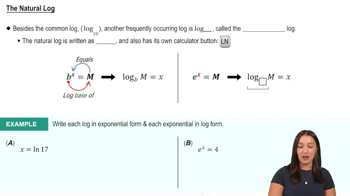
The Natural Log
957
views
20
rank
5:26
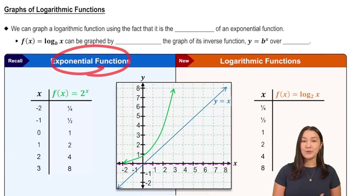
Graphs of Logarithmic Functions
915
views
19
rank
Terms in this set (14)
Hide definitions
Logarithm
Inverse operation to exponentiation, revealing the power a base must be raised to for a given result.
Exponential Function
Mathematical relationship where a constant base is raised to a variable exponent, producing rapid growth or decay.
Logarithmic Function
Function expressing the exponent needed for a base to yield a specific value, mirroring exponential functions.
Base
Constant value in exponentials and logarithms that is repeatedly multiplied or used as the reference for powers.
Exponent
Number indicating how many times a base is multiplied by itself in exponential expressions.
Logarithmic Form
Equation format showing the exponent required for a base to reach a certain value, typically written as log_b(x).
Exponential Form
Equation format where a base is raised to an exponent to produce a value, such as b^x = m.
Inverse Function
Function that reverses the effect of another, such as logarithms undoing exponentials and vice versa.
Common Logarithm
Logarithm with base 10, often written simply as log(x), and widely used in scientific calculations.
Natural Logarithm
Logarithm with base e, denoted as ln(x), frequently appearing in calculus and continuous growth models.
Reflection
Graphical transformation where a function's graph is flipped over a line, such as y = x for exponentials and logarithms.
Vertical Asymptote
Line that a graph approaches but never touches, such as x = 0 for logarithmic functions.
Domain
Set of all possible input values for a function, for logarithms typically all positive real numbers.
Range
Set of all possible output values for a function, for logarithmic functions usually all real numbers.
 BackBack

 7:30
7:30