Skip to main content
Calculus
My Course
Learn
Exam Prep
AI Tutor
Study Guides
Textbook Solutions
Flashcards
Explore
Try the app
My Course
Learn
Exam Prep
AI Tutor
Study Guides
Textbook Solutions
Flashcards
Explore
Try the app
Back
Motion Analysis quiz
You can tap to flip the card.
What is the relationship between position, velocity, and acceleration in motion analysis?
You can tap to flip the card.
👆
What is the relationship between position, velocity, and acceleration in motion analysis?
Position is s(t), velocity is the first derivative of position (v = ds/dt), and acceleration is the second derivative of position (a = d^2s/dt^2).
Track progress
Control buttons has been changed to "navigation" mode.
1/15
Related flashcards
Related practice
Recommended videos
Motion Analysis definitions
Motion Analysis
15 Terms
Motion Analysis
4. Applications of Derivatives
3 problems
Topic
Justin
Implicit Differentiation
4. Applications of Derivatives
4 problems
Topic
David-Paige
4. Applications of Derivatives
5 topics
10 problems
Chapter
Justin
Guided course
06:29
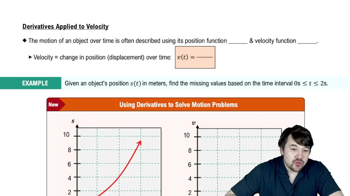
Derivatives Applied To Velocity
1594
views
33
rank
Guided course
06:51
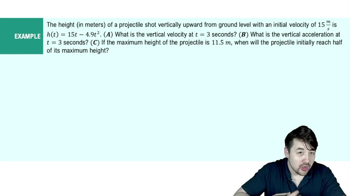
Derivatives Applied To Acceleration Example 2
845
views
12
rank
Guided course
06:15
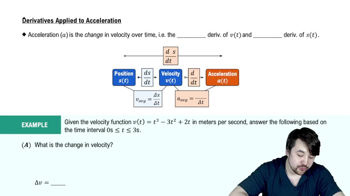
Derivatives Applied To Acceleration
983
views
26
rank
Terms in this set (15)
Hide definitions
What is the relationship between position, velocity, and acceleration in motion analysis?
Position is s(t), velocity is the first derivative of position (v = ds/dt), and acceleration is the second derivative of position (a = d^2s/dt^2).
How do you find the velocity function from a position function?
Take the first derivative of the position function with respect to time; v(t) = ds/dt.
What does the position function s(t) represent in motion analysis?
It represents the location of an object at a given time t.
How is displacement calculated over a time interval?
Displacement is the final position minus the initial position: s(final) - s(initial).
What is the formula for average velocity over a time interval?
Average velocity is the change in position divided by the change in time: (s(final) - s(initial)) / (t(final) - t(initial)).
How do you find instantaneous velocity at a specific time?
Plug the specific time into the velocity function; v(t) at that time gives the instantaneous velocity.
What is the difference between speed and velocity?
Speed is the absolute value of velocity and always positive, while velocity can be negative or positive depending on direction.
How do you calculate speed from velocity?
Take the absolute value of the velocity; speed = |v|.
What is the mathematical definition of acceleration?
Acceleration is the first derivative of velocity or the second derivative of position with respect to time.
How do you find the change in velocity over a time interval?
Subtract the initial velocity from the final velocity: v(final) - v(initial).
What is the formula for average acceleration?
Average acceleration is the change in velocity divided by the change in time: (v(final) - v(initial)) / (t(final) - t(initial)).
What are the units for acceleration in motion analysis?
Acceleration is measured in distance per squared time, such as meters per second squared (m/s^2).
How do you find the acceleration function from a velocity function?
Take the first derivative of the velocity function with respect to time; a(t) = dv/dt.
How do you calculate instantaneous acceleration at a specific time?
Plug the specific time into the acceleration function; a(t) at that time gives the instantaneous acceleration.
What is the difference between average and instantaneous values in motion analysis?
Average values are calculated over a time interval between two points, while instantaneous values are calculated at a single specific point in time.
 BackBack
 06:29
06:29