Skip to main content
Calculus
My Course
Learn
Exam Prep
AI Tutor
Study Guides
Textbook Solutions
Flashcards
Explore
Try the app
My Course
Learn
Exam Prep
AI Tutor
Study Guides
Textbook Solutions
Flashcards
Explore
Try the app
Back
Substitution quiz
You can tap to flip the card.
What is the main purpose of the substitution method in evaluating integrals?
You can tap to flip the card.
👆
What is the main purpose of the substitution method in evaluating integrals?
The substitution method simplifies integrals involving composite functions by changing variables, making them easier to evaluate.
Track progress
Control buttons has been changed to "navigation" mode.
1/15
Related flashcards
Related practice
Recommended videos
Substitution definitions
Substitution
15 Terms
Substitution
8. Definite Integrals
5 problems
Topic
Ernest
Average Value of a Function
8. Definite Integrals
5 problems
Topic
Ernest
8. Definite Integrals - Part 1 of 2
5 topics
14 problems
Chapter
Ernest
8. Definite Integrals - Part 2 of 2
1 topic
3 problems
Chapter
Ernest
04:40
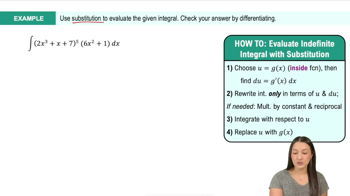
Indefinite Integrals Example 1
1067
views
34
rank
04:27
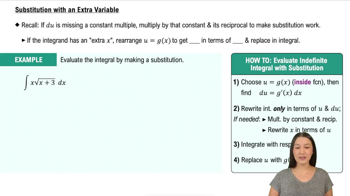
Substitution With an Extra Variable
884
views
20
rank
06:36
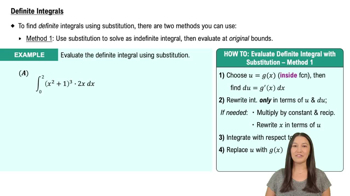
Definite Integrals
749
views
19
rank
Terms in this set (15)
Hide definitions
What is the main purpose of the substitution method in evaluating integrals?
The substitution method simplifies integrals involving composite functions by changing variables, making them easier to evaluate.
How is substitution related to the chain rule in calculus?
Substitution is essentially the reverse process of the chain rule, used for integrating composite functions.
When choosing a substitution variable u, what should you typically select?
You should select the inside function, often found inside parentheses, under a radical, or in an exponent.
What is the next step after choosing u in the substitution process?
After choosing u, you find du by differentiating u with respect to x and multiplying by dx.
How do you rewrite the integral after finding u and du?
You rewrite the integral entirely in terms of u and du, replacing all x terms.
What should you do if du is off by a constant compared to the dx in your integral?
Multiply by the necessary constant to match du, and also multiply by its reciprocal to keep the integral's value unchanged.
How do you handle extra factors of x in the integral when using substitution?
Express x in terms of u using the substitution equation and replace x in the integral.
What is the power rule for integration used after substitution?
The power rule states that the integral of u^n du is (u^(n+1))/(n+1) plus the constant of integration.
Why must you return the variable to x after integrating with respect to u?
Because the original integral was in terms of x, you substitute back to x for the final answer.
What is the difference between indefinite and definite integrals in substitution?
Indefinite integrals require adding a constant of integration, while definite integrals involve evaluating at specific bounds.
What are the two methods for handling bounds in definite integrals using substitution?
You can either ignore bounds until the end and substitute back to x, or transform the bounds using the substitution and keep everything in terms of u.
How do you transform bounds when using substitution in definite integrals?
Plug the original bounds into the substitution equation to get new bounds in terms of u.
What is the fundamental theorem of calculus used for in definite integrals?
It is used to evaluate the antiderivative at the upper and lower bounds to find the value of the definite integral.
What should you do if your integral contains an extra variable not accounted for by u and du?
Rewrite the extra variable in terms of u using the substitution equation, then substitute it into the integral.
Is there a preferred method for handling bounds in substitution for definite integrals?
No, both methods—substituting back to x or transforming bounds to u—are valid and will yield the same result.
 BackBack
 04:40
04:40