Skip to main content
Calculus
My Course
Learn
Exam Prep
AI Tutor
Study Guides
Textbook Solutions
Flashcards
Explore
Try the app
My Course
Learn
Exam Prep
AI Tutor
Study Guides
Textbook Solutions
Flashcards
Explore
Try the app
Back
The Chain Rule definitions
You can tap to flip the card.
Chain Rule
You can tap to flip the card.
👆
Chain Rule
A method for finding the derivative of a composite function by differentiating from the outermost function inward.
Track progress
Control buttons has been changed to "navigation" mode.
1/15
Related flashcards
Related practice
Recommended videos
The Chain Rule quiz #1
The Chain Rule
10 Terms
The Chain Rule
3. Techniques of Differentiation
4 problems
Topic
Ernest
Derivatives of Trig Functions
3. Techniques of Differentiation
3 problems
Topic
Ally
3. Techniques of Differentiation
5 topics
10 problems
Chapter
Ally
07:39
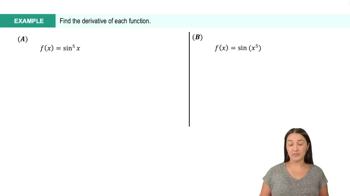
Intro to the Chain Rule Example 2
1799
views
40
rank
03:52
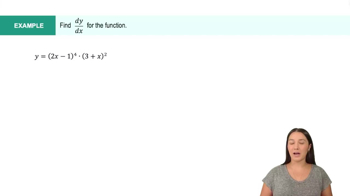
Intro to the Chain Rule Example 3
1700
views
36
rank
07:01
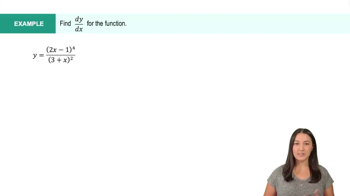
Intro to the Chain Rule Example 1
2012
views
47
rank
1
comments
Terms in this set (15)
Hide definitions
Chain Rule
A method for finding the derivative of a composite function by differentiating from the outermost function inward.
Composite Function
An expression formed by applying one function to the result of another, often written as f(g(x)).
Outside Function
The function applied last in a composite, differentiated first when using the chain rule.
Inside Function
The function nested within another, treated as a variable when differentiating the outside function.
Power Rule
A shortcut for differentiating expressions with exponents by multiplying by the exponent and reducing it by one.
Leibnitz Notation
A symbolic way to express derivatives, such as dydx = dydu * dudx, useful for the chain rule.
Parentheses
A notation often used to visually group the inside function within a composite expression.
Simplification
The process of combining like terms or constants after differentiation to present the derivative in its cleanest form.
Trig Function
A function like sine or cosine, which may be raised to a power and require rewriting for easier differentiation.
Variable
A symbol, often x, treated as a placeholder when differentiating composite functions.
Exponent
A number indicating how many times a base is multiplied by itself, crucial in applying the power rule.
Derivative
A measure of how a function changes as its input changes, found using rules like the chain rule.
Notation
A system of symbols used to represent mathematical ideas, such as derivatives and composite functions.
Sine Function
A trigonometric function often appearing in composite forms, requiring careful application of the chain rule.
Cosine Function
The derivative of the sine function, frequently encountered when differentiating trigonometric composites.
 BackBack
 07:39
07:39