Skip to main content
Calculus
My Course
Learn
Exam Prep
AI Tutor
Study Guides
Textbook Solutions
Flashcards
Explore
Try the app
My Course
Learn
Exam Prep
AI Tutor
Study Guides
Textbook Solutions
Flashcards
Explore
Try the app
Back
The Second Derivative Test definitions
You can tap to flip the card.
Second Derivative Test
You can tap to flip the card.
👆
Second Derivative Test
A method using the sign of the second derivative at a critical point to determine if it is a local maximum or minimum.
Track progress
Control buttons has been changed to "navigation" mode.
1/14
Related flashcards
Related practice
Recommended videos
The Second Derivative Test quiz
The Second Derivative Test
15 Terms
The Second Derivative Test
5. Graphical Applications of Derivatives
3 problems
Topic
Jonathan
Curve Sketching
5. Graphical Applications of Derivatives
3 problems
Topic
Justin
5. Graphical Applications of Derivatives
7 topics
13 problems
Chapter
Ernest
06:02
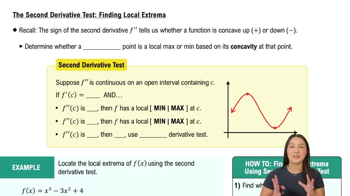
The Second Derivative Test: Finding Local Extrema
1282
views
17
rank
05:34
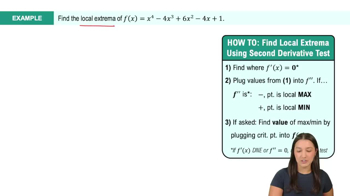
The Second Derivative Test: Finding Local Extrema Example 1
665
views
18
rank
Terms in this set (14)
Hide definitions
Second Derivative Test
A method using the sign of the second derivative at a critical point to determine if it is a local maximum or minimum.
Concavity
Describes whether a graph bends upward or downward, determined by the sign of the second derivative.
Critical Point
A value where the first derivative equals zero, serving as a candidate for local extrema.
Local Maximum
A point where the function value is higher than all nearby points, indicated by a negative second derivative.
Local Minimum
A point where the function value is lower than all nearby points, indicated by a positive second derivative.
First Derivative
Represents the slope of the function and is used to locate critical points by setting it equal to zero.
Second Derivative
Measures the rate of change of the first derivative and reveals the function's concavity.
Sign of the Second Derivative
Indicates whether a function is concave up or down at a critical point, guiding the classification of extrema.
Power Rule
A differentiation technique used to find derivatives of polynomial terms efficiently.
Local Extrema
Collective term for local maximum and minimum points within a function's domain.
First Derivative Test
An alternative method for classifying critical points when the second derivative is zero or undefined.
Optimization
The process of finding maximum or minimum values of a function, often applied in economics and calculus.
Marginal Analysis
A technique in economics using derivatives to assess changes in cost or benefit with respect to small changes in input.
Factoring
A method for simplifying derivatives by expressing them as products, aiding in solving equations for critical points.
 BackBack
 06:02
06:02