Skip to main content
Calculus
My Course
Learn
Exam Prep
AI Tutor
Study Guides
Textbook Solutions
Flashcards
Explore
Try the app
My Course
Learn
Exam Prep
AI Tutor
Study Guides
Textbook Solutions
Flashcards
Explore
Try the app
Back
Transformations quiz
You can tap to flip the card.
What are the three basic types of function transformations?
You can tap to flip the card.
👆
What are the three basic types of function transformations?
The three basic types are reflections, shifts, and stretches.
Track progress
Control buttons has been changed to "navigation" mode.
1/15
Related flashcards
Related practice
Recommended videos
Transformations definitions
Transformations
14 Terms
Transformations
0. Functions
3 problems
Topic
Ally
Combining Functions
0. Functions
4 problems
Topic
Patrick
0. Functions - Part 1 of 2
7 topics
14 problems
Chapter
Patrick
0. Functions - Part 2 of 2
8 topics
12 problems
Chapter
David-Paige
Guided course
5:25
Intro to Transformations
1820
views
67
rank
Terms in this set (15)
Hide definitions
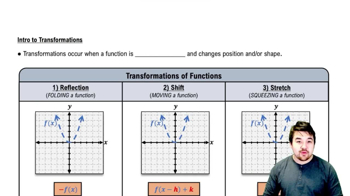
What are the three basic types of function transformations?
The three basic types are reflections, shifts, and stretches.
What does a reflection transformation do to a function's graph?
A reflection folds the graph over a certain axis, such as the x-axis.
How is a reflection over the x-axis represented in function notation?
It is represented by making the function negative, as in -f(x).
What is a shift transformation?
A shift moves the function to a new position without changing its shape.
How is a shift written in function notation?
It is written as f(x - h) + k, where h is the horizontal shift and k is the vertical shift.
What does a stretch transformation do to a function's graph?
A stretch transformation squeezes or expands the graph vertically.
How is a vertical stretch represented in function notation?
It is represented by multiplying the function by a constant, as in c·f(x).
If a function is written as f(x - 3) + 2, what type of transformation has occurred?
This is a shift: 3 units to the right and 2 units up.
What transformation occurs in the function -|x|?
This is a reflection of the absolute value function over the x-axis.
How can you identify a vertical stretch in a function's equation?
A vertical stretch is indicated by a constant multiplied in front of the function, such as 2f(x).
Can multiple transformations occur in a single function?
Yes, a function can undergo multiple transformations at the same time.
What does the 'h' represent in the transformation f(x - h) + k?
The 'h' represents the horizontal shift of the function.
What does the 'k' represent in the transformation f(x - h) + k?
The 'k' represents the vertical shift of the function.
If a function is written as -2|x|, what transformations have occurred?
There is a reflection over the x-axis and a vertical stretch by a factor of 2.
Why is it important to identify transformations when matching functions to graphs?
Identifying transformations helps you determine how the original graph has changed, making it easier to match equations to their corresponding graphs.
 BackBack

 5:25
5:25