Skip to main content
Calculus
My Course
Learn
Exam Prep
AI Tutor
Study Guides
Textbook Solutions
Flashcards
Explore
Try the app
My Course
Learn
Exam Prep
AI Tutor
Study Guides
Textbook Solutions
Flashcards
Explore
Try the app
Back
Trigonometric Identities definitions
You can tap to flip the card.
Trigonometric Identity
You can tap to flip the card.
👆
Trigonometric Identity
A universally true equation involving trigonometric functions, used to simplify or verify expressions.
Track progress
Control buttons has been changed to "navigation" mode.
1/15
Related flashcards
Related practice
Recommended videos
Trigonometric Identities quiz
Trigonometric Identities
15 Terms
Trigonometric Identities
0. Functions
2 problems
Topic
Inverse Trigonometric Functions
0. Functions
3 problems
Topic
Jonathan
0. Functions - Part 1 of 2
7 topics
14 problems
Chapter
Patrick
0. Functions - Part 2 of 2
8 topics
12 problems
Chapter
David-Paige
7:17
Verifying Trig Equations as Identities
935
views
8
rank
6:36
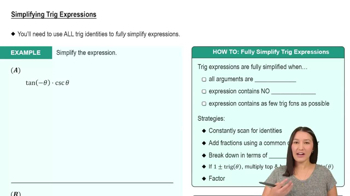
Simplifying Trig Expressions
1573
views
12
rank
5:18
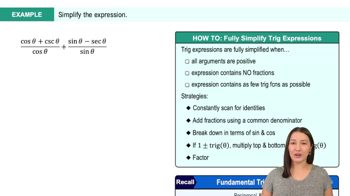
Simplifying Trig Expressions Example 2
998
views
9
rank
1
comments
Terms in this set (15)
Hide definitions
Trigonometric Identity
A universally true equation involving trigonometric functions, used to simplify or verify expressions.
Even-Odd Identity
A rule describing how trigonometric functions behave when their arguments are negated.
Pythagorean Identity
A relationship connecting squares of sine and cosine, or tangent and secant, or cotangent and cosecant.
Double Angle Identity
A formula expressing a trigonometric function of twice an angle in terms of functions of the original angle.
Argument
The angle input for a trigonometric function, often denoted by theta.
Fraction Elimination
A simplification goal where expressions are rewritten to avoid division by trigonometric functions.
Difference of Squares
An algebraic pattern used to factor expressions like 1 minus the square of a trigonometric function.
Linear Trigonometric Equation
An equation involving a single trigonometric function of an angle, set equal to a constant.
Unit Circle
A geometric tool for finding angle solutions where trigonometric functions take specific values.
Simplification Strategy
A systematic approach for rewriting trigonometric expressions to their most reduced form.
Verification
The process of showing two sides of a trigonometric equation are equivalent using identities.
Positive Argument
A requirement that all angles inside trigonometric functions are non-negative for simplification.
Trig Function Reduction
The process of expressing an equation in terms of fewer or only one trigonometric function.
Cotangent
A trigonometric function equal to the ratio of cosine to sine for a given angle.
Secant
A trigonometric function representing the reciprocal of cosine for a given angle.
 BackBack

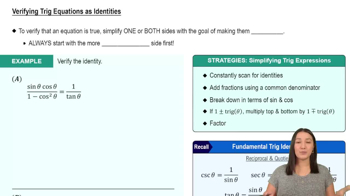
 7:17
7:17