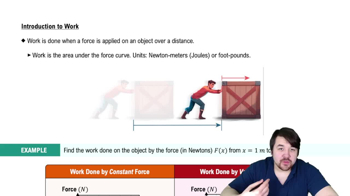
What is the general formula for calculating work when force is constant?
Work equals force times distance (W = F × d) when the force applied is constant.
In what units is work measured when force is in newtons and distance is in meters?
Work is measured in joules when force is in newtons and distance is in meters.
How do you calculate work when the force applied varies with distance?
You calculate work by integrating the force function over the distance, i.e., W = ∫ F(x) dx from a to b.
What does the area under the force vs. distance curve represent?
The area under the force vs. distance curve represents the total work done.
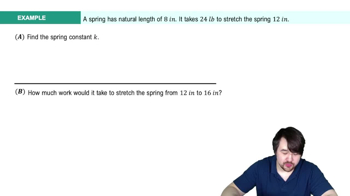
What is Hooke's Law for springs, and how is the force function defined?
Hooke's Law states that the force required to stretch or compress a spring is F(x) = kx, where k is the spring constant and x is the displacement from equilibrium.
How do you find the work done to stretch or compress a spring from position a to b?
Integrate the force function: W = ∫ from a to b of kx dx, which results in W = (k/2)(b^2 - a^2).
What does the spring constant k represent and what are its units?
The spring constant k measures the stiffness of the spring and is given in newtons per meter or pounds per foot.
In lifting problems, what does the force correspond to?
In lifting problems, the force corresponds to the weight of the object being lifted, which may change as the object is lifted.
How do you convert mass density (kg/m) to weight density for use in work problems?
Multiply the mass density by 9.8 m/s² (Earth's gravitational acceleration) to get weight density in newtons per meter.
What is the general integral setup for work in lifting problems with variable weight?
The work is given by W = ∫ from 0 to h of weight density × (total length - y) dy, where y is the height lifted.
How do you calculate the total work required to lift both a rope and a bucket?
Calculate the work for the rope using integration (variable force), the work for the bucket using force × distance (constant force), and add the two results.
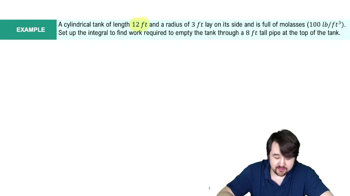
In pumping liquids, what three main components are multiplied inside the work integral?
The three components are the liquid's weight density, the cross-sectional area, and the distance each slice of liquid is lifted.
How do you determine the distance each slice of liquid must be lifted in a tank?
The distance is the height to which the liquid is pumped minus the variable y representing the current height of the slice.
What is the general integral form for work required to pump a liquid from a tank?
W = ∫ from 0 to h of ρA(h - y) dy, where ρ is weight density, A is cross-sectional area, h is the height, and y is the variable of integration.
Why might the cross-sectional area in a pumping problem be a function of y?
If the tank's shape changes with height, the cross-sectional area varies with y and must be expressed as a function of y in the integral.
 Back
Back
 06:02
06:02