Pearson+ LogoPearson+ Logo

Actin Based Movement quiz #1 Flashcards

Back
Actin Based Movement quiz #1
Control buttons has been changed to "navigation" mode.
1/10
  • What cellular structures and processes does cell crawling depend on?

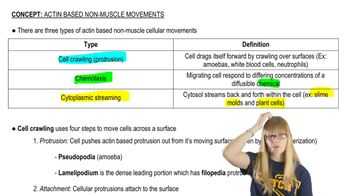
    Cell crawling depends on actin-based protrusions (such as pseudopodia, lamellipodia, or filopodia), the attachment of these protrusions to surfaces via integrins (transmembrane proteins), and a cycle of protrusion, attachment, translocation (dragging the cell body forward), and detachment.
  • What is chemotaxis in the context of actin-based movement?

    Chemotaxis is the movement of a cell in response to changes in chemical concentrations in its environment. It involves the cell detecting and moving toward or away from specific chemicals.
  • How does cytoplasmic streaming differ from cell crawling?

    Cytoplasmic streaming involves the movement of cytosol within the cell while the cell's exterior remains stationary. In contrast, cell crawling moves the entire cell across a surface.
  • Which actin-based protrusion is most commonly associated with amoebas?

    Amoebas most commonly use pseudopodia as their actin-based protrusions. These structures extend from the cell surface to facilitate movement.
  • What role do integrins play during the attachment step of cell crawling?

    Integrins act as transmembrane proteins that anchor the cell's protrusions to the surface or extracellular matrix. This attachment is essential for the cell to move forward.
  • Why is the translocation step important in cell crawling?

    Translocation allows the cell to drag its body forward after the leading edge has attached to the surface. This step ensures the entire cell moves rather than just the protrusion.
  • What happens during the detachment step of cell crawling?

    During detachment, the cell releases its integrins from the surface, allowing it to repeat the crawling cycle. This release is necessary for continued movement.
  • In which types of cells can cytoplasmic streaming be observed?

    Cytoplasmic streaming can be observed in plant cells and slime molds. It is visible under a microscope if you know what to look for.
  • What is the function of lamellipodia and filopodia in cell crawling?

    Lamellipodia and filopodia are actin-based protrusions at the leading edge of the cell that help extend the cell forward. They are found in various organisms and facilitate movement.
  • How do integrins resemble Velcro in the process of cell crawling?

    Integrins resemble Velcro because they stick the cell's protrusions to the surface, anchoring the cell during movement. This anchoring prevents the cell from sliding back and enables forward motion.