Skip to main content
Cell Biology
My Course
Learn
Exam Prep
AI Tutor
Study Guides
Flashcards
Explore
Try the app
My Course
Learn
Exam Prep
AI Tutor
Study Guides
Flashcards
Explore
Try the app
Back
Activated Carriers definitions
You can tap to flip the card.
Activated Carrier
You can tap to flip the card.
👆
Activated Carrier
Small molecule that stores and transfers energy or electrons between cellular reactions, enabling coupling of different metabolic processes.
Track progress
Control buttons has been changed to "navigation" mode.
1/15
Related flashcards
Related practice
Recommended videos
Activated Carriers quiz #1
Activated Carriers
10 Terms
Activated Carriers
3. Energy
6 problems
Topic
Enzymes
3. Energy
6 problems
Topic
3. Energy - Part 1 of 2
4 topics
9 problems
Chapter
3. Energy - Part 2 of 2
3 topics
8 problems
Chapter
Guided course
10:05
Activated Carriers
694
views
5
rank
1
comments
Terms in this set (15)
Hide definitions
Activated Carrier
Small molecule that stores and transfers energy or electrons between cellular reactions, enabling coupling of different metabolic processes.
ATP
Molecule with three phosphate groups whose bond hydrolysis releases energy used to drive energetically unfavorable cellular reactions.
ADP
Molecule formed after removal of a phosphate group from ATP, representing a lower-energy state in cellular energy transfer.
Phosphate Group
Chemical group whose covalent bond hydrolysis in ATP releases energy for cellular processes.
NAD+
Electron-accepting molecule that becomes reduced during metabolic reactions, enabling energy storage in the form of high-energy electrons.
NADH
Reduced form of an electron carrier, containing high-energy electrons that can be donated to power other reactions.
NADPH
Electron carrier similar to NADH, primarily involved in photosynthesis and anabolic reactions, storing high-energy electrons.
FADH2
Electron-rich molecule generated during cellular respiration, used to transfer energy to the electron transport chain.
Electron Carrier
Molecule that temporarily holds and transports electrons, facilitating energy transfer between metabolic reactions.
Reaction Coupling
Process where energy released from a favorable reaction is used to drive an unfavorable reaction within the cell.
Cellular Respiration
Metabolic pathway in which cells extract energy from nutrients, generating ATP and reduced electron carriers.
Photosynthesis
Process in plant cells that converts light energy into chemical energy, producing ATP and reduced electron carriers.
Oxidation
Loss of electrons from a molecule, often resulting in energy release or transfer to another carrier.
Reduction
Gain of electrons by a molecule, increasing its energy content and enabling it to act as an energy donor.
Delta G
Symbol representing the change in free energy during a reaction, indicating whether a process is energetically favorable or not.
 BackBack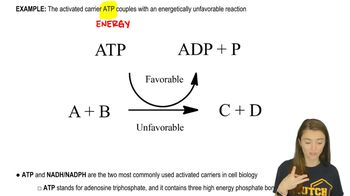
 10:05
10:05