Which proteins are primarily involved in cell-to-cell recognition in tissues and organs?
Cell Adhesion Molecules (CAMs), especially cadherins, are primarily involved in cell-to-cell recognition by connecting adjacent cells in tissues and organs.
What is the role of cadherins in cell-to-cell adhesion?
Cadherins are glycoproteins located in the plasma membrane that require calcium to function and are responsible for binding cells together, playing a critical role in cell-to-cell adhesion.
Besides cadherins, which other cell adhesion molecules are involved in cell-to-cell recognition, and how do they differ?
Lectins and selectins are also cell adhesion molecules involved in cell-to-cell recognition. Lectins bind to sugars (heterophilic binding), while selectins are glycoproteins important in white blood cell interactions and inflammation, with three classes: endothelial, platelet, and leukocyte.
What is the difference between homophilic and heterophilic cell adhesion?
Homophilic adhesion uses the same type of molecule on both cells, while heterophilic adhesion uses different molecules on each cell. This classification helps describe how cells connect to each other.
Why is it important for cells in tissues and organs to adhere to each other?
Cell adhesion ensures that tissues and organs maintain their structure and can function uniformly. Without adhesion, cells could separate and fail to work together for a common purpose.
Where are cadherins located within a cell?
Cadherins are located in the plasma membrane of cells. This positioning allows them to interact with adjacent cells for adhesion.
What essential ion is required for cadherins to function properly?
Cadherins require calcium ions to function. Without calcium, cadherins cannot effectively bind cells together.
Which developmental process are cadherins especially important for?
Cadherins play a critical role in the epithelial-mesenchymal transition during early development. This process is important for forming tissues such as blood, muscle, and bone.
What type of binding do lectins perform in cell adhesion?
Lectins perform heterophilic binding by attaching to sugars on other cells. This distinguishes them from molecules that bind to themselves.
Why should students avoid confusing the classical types of cadherins with the classes of selectins?
Cadherins have classical types named endothelial, placental, and neural, while selectins have classes called endothelial, platelet, and leukocyte. Mixing these up can lead to incorrect answers on exams.
 Back
Back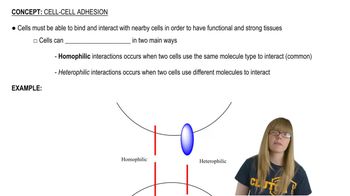
 06:58
06:58