Skip to main content
Cell Biology
My Course
Learn
Exam Prep
AI Tutor
Study Guides
Flashcards
Explore
Try the app
My Course
Learn
Exam Prep
AI Tutor
Study Guides
Flashcards
Explore
Try the app
Back
Enzymes definitions
You can tap to flip the card.
Enzyme
You can tap to flip the card.
👆
Enzyme
Biological catalyst, often a protein or RNA, that accelerates chemical reactions by lowering activation energy without being consumed.
Track progress
Control buttons has been changed to "navigation" mode.
1/15
Related flashcards
Related practice
Recommended videos
Enzymes quiz #1
Enzymes
10 Terms
Enzymes
3. Energy
6 problems
Topic
Enzyme Kinetics
3. Energy
7 problems
Topic
3. Energy - Part 1 of 2
4 topics
9 problems
Chapter
3. Energy - Part 2 of 2
3 topics
8 problems
Chapter
Guided course
03:20
Enzyme Basics
924
views
14
rank
Guided course
05:15
Substrate Interactions
637
views
7
rank
Guided course
03:22
Enzyme Regulation
798
views
5
rank
Terms in this set (15)
Hide definitions
Enzyme
Biological catalyst, often a protein or RNA, that accelerates chemical reactions by lowering activation energy without being consumed.
Substrate
Specific molecule upon which a biological catalyst acts, binding at a unique site to undergo a chemical transformation.
Activation Energy
Minimum energy required for reactants to reach a transition state and proceed to product formation in a chemical reaction.
Transition State
Unstable, high-energy configuration between reactants and products, stabilized by biological catalysts to facilitate reactions.
Active Site
Specialized groove within a biological catalyst where a specific molecule binds and the chemical transformation occurs.
Lock and Key Model
Mechanism where a biological catalyst and its specific molecule fit together with precise complementarity, like a key in a lock.
Induced Fit Model
Mechanism where a biological catalyst changes shape upon binding its specific molecule, enhancing the fit for catalysis.
Cofactor
Non-protein helper, either organic or inorganic, required for optimal activity of a biological catalyst.
Coenzyme
Organic molecule, often derived from vitamins, that assists a biological catalyst in facilitating chemical transformations.
Prosthetic Group
Tightly bound non-protein component, organic or inorganic, essential for the function of a biological catalyst.
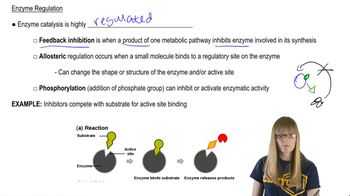
Feedback Inhibition
Regulatory process where the end product of a pathway suppresses the activity of a biological catalyst earlier in the pathway.
Allosteric Regulation
Control mechanism where a small molecule binds to a site other than the active region, altering the catalyst's activity.
Phosphorylation
Addition of a phosphate group to a biological catalyst, which can either enhance or suppress its activity.
Metastable State
Condition where molecules are thermodynamically unstable but persist due to insufficient energy to proceed to products.
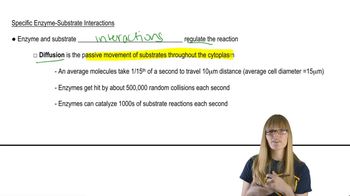
Diffusion
Random movement of molecules within cells, enabling frequent encounters between biological catalysts and their specific molecules.
 BackBack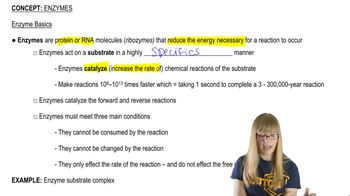
 03:20
03:20