Skip to main content
Cell Biology
My Course
Learn
Exam Prep
AI Tutor
Study Guides
Flashcards
Explore
Try the app
My Course
Learn
Exam Prep
AI Tutor
Study Guides
Flashcards
Explore
Try the app
Back
Fermentation quiz
You can tap to flip the card.
What is fermentation and when does it occur?
You can tap to flip the card.
👆
What is fermentation and when does it occur?
Fermentation is the process that breaks down sugar to produce ATP in the absence of oxygen, occurring during anaerobic respiration.
Track progress
Control buttons has been changed to "navigation" mode.
1/15
Related flashcards
Related practice
Recommended videos
Fermentation definitions
Fermentation
15 Terms
Fermentation
10. Anaerobic Respiration
7 problems
Topic
Gluconeogenesis
10. Anaerobic Respiration
7 problems
Topic
10. Anerobic Respiration
4 topics
12 problems
Chapter
Guided course
09:58
Fermentation
748
views
10
rank
1
comments
Terms in this set (15)
Hide definitions
What is fermentation and when does it occur?
Fermentation is the process that breaks down sugar to produce ATP in the absence of oxygen, occurring during anaerobic respiration.
What are the two main steps of anaerobic respiration?
The two main steps are glycolysis and fermentation.
Why is fermentation necessary after glycolysis in anaerobic conditions?
Fermentation is necessary to regenerate NAD+ from NADH, allowing glycolysis to continue without oxygen.
What molecule does glycolysis require to continue, and how is it regenerated in anaerobic respiration?
Glycolysis requires NAD+ to continue, which is regenerated by fermentation in anaerobic respiration.
What are the two types of fermentation and what do they produce?
The two types are alcohol fermentation, which produces ethanol and CO2, and lactic acid fermentation, which produces lactate (lactic acid).
Which organisms commonly use alcohol fermentation?
Yeast cells commonly use alcohol fermentation.
What is the main byproduct of lactic acid fermentation in muscle cells?
The main byproduct is lactic acid (lactate).
How many ATP molecules are produced by glycolysis and fermentation combined in anaerobic respiration?
About 4 ATP molecules are produced in total.
How does the efficiency of anaerobic respiration compare to aerobic respiration?
Anaerobic respiration is much less efficient, producing only about 4 ATP compared to 32-34 ATP in aerobic respiration.
What happens to the byproducts of fermentation such as ethanol and lactic acid?
These byproducts are not further utilized for energy and are considered waste products.
What causes muscle soreness after intense exercise related to fermentation?
Muscle soreness is caused by the accumulation of lactic acid produced during lactic acid fermentation.
What is the role of pyruvate in fermentation?
Pyruvate acts as an electron acceptor, receiving electrons from NADH to regenerate NAD+.
What gas is produced during alcohol fermentation and what is its practical use?
CO2 is produced, which is used to make bread rise during baking.
Why do organisms use anaerobic respiration even though it is inefficient?
Organisms use anaerobic respiration when oxygen is not available or they live in environments without oxygen.
What happens to NADH during fermentation?
NADH is oxidized back to NAD+, allowing glycolysis to continue producing ATP.
 BackBack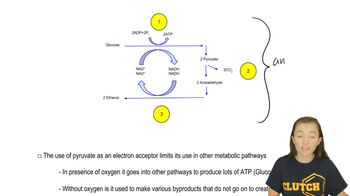
 09:58
09:58