What is the first part of the immune system to respond to a pathogen?
The innate immune system is the first to respond to a pathogen.
What type of receptors do innate immune cells use to recognize pathogens?
Innate immune cells use pattern recognition receptors, such as toll-like receptors, to recognize pathogens.
What happens after a pathogen is recognized by the innate immune system?
White blood cells or macrophages engulf and degrade the pathogen, then present its antigens via MHC molecules.
What is the role of antigen-presenting cells (APCs) in immune system collaboration?
APCs, like dendritic cells, process pathogens and present their antigens to activate T helper cells.
How do T helper cells become activated?
T helper cells are activated when APCs present antigens to them using MHC molecules.
What are cytokines and what is their main function?
Cytokines are inflammatory molecules secreted by activated T helper cells that enhance the immune response.
How do cytokines affect white blood cells during an infection?
Cytokines increase the number of white blood cells, promote their migration to the infection site, and improve cell adhesion.
Which immune system do T helper cells belong to?
T helper cells are part of the adaptive immune system.
What are the two main types of T helper cells and their functions?
TH1 cells activate macrophages and cytotoxic T cells to target internalized pathogens, while TH2 cells stimulate B cells to produce antibodies against extracellular pathogens.
How do TH1 cells contribute to the immune response?
TH1 cells activate macrophages and cytotoxic T cells, which help kill internalized pathogens.
What is the function of TH2 cells in immune system collaboration?
TH2 cells activate B cells to produce antibodies that target extracellular pathogens.
How do T helper cells bridge the innate and adaptive immune systems?
T helper cells, once activated by the innate immune system, further activate cells in the adaptive immune system, such as cytotoxic T cells and B cells.
What is the role of dendritic cells in immune system collaboration?
Dendritic cells act as antigen-presenting cells, taking up antigens, processing them, and presenting them to T helper cells.
What is the significance of MHC molecules in immune system collaboration?
MHC molecules display processed antigens on the surface of APCs, enabling activation of T helper cells.
Why is the interaction between the innate and adaptive immune systems important?
The interaction ensures a comprehensive immune response, with cytokines playing a key role in connecting both systems during infection.
 Back
Back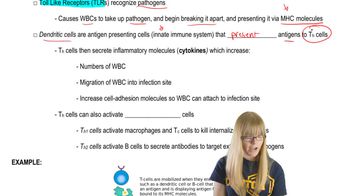
 04:02
04:02