Back

RNA interference quiz

Control buttons has been changed to "navigation" mode.
1/15
  • What is the main purpose of RNA interference (RNAi) in scientific research?

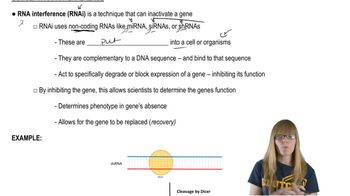
    RNA interference is used to inactivate or silence specific genes to study their function by observing changes in cell phenotype.
  • What types of RNA are commonly used in RNA interference?

    MicroRNA (miRNA), small interfering RNA (siRNA), and short hairpin RNA (shRNA) are commonly used in RNA interference.
  • How do noncoding RNAs used in RNAi affect gene expression?

    They bind to complementary DNA or mRNA sequences, recruiting proteins that degrade the target mRNA or block its translation.
  • What is a phenotype, and how is it used in RNAi experiments?

    A phenotype is the observable characteristics of a cell, and changes in phenotype after gene knockdown help identify gene function.
  • What happens to a gene's mRNA when RNAi is successful?

    The mRNA is degraded or its translation is blocked, preventing the gene from being expressed as a protein.
  • Why is complementarity important in RNAi?

    Complementarity ensures that the noncoding RNA binds specifically to the target DNA or mRNA sequence, allowing precise gene silencing.
  • What is the role of proteins in the RNAi process?

    Proteins are recruited by the RNA-RNA or RNA-DNA complex to degrade the target mRNA or inhibit its translation.
  • How can RNAi help confirm the function of a gene?

    By knocking down a gene and observing the resulting phenotype, then restoring the gene to see if the phenotype returns to normal.
  • What is meant by 'gene knockdown' in the context of RNAi?

    Gene knockdown refers to reducing or silencing the expression of a specific gene using RNA interference.
  • What is the first step in the cellular processing of RNAi molecules?

    A double-stranded RNA is introduced and then cleaved by an enzyme into smaller fragments.
  • After cleavage, what happens to the double-stranded RNA in RNAi?

    It is loaded into a protein complex, and one strand is degraded, leaving a single RNA strand bound to the protein.
  • What does the single RNA strand do in the RNAi mechanism?

    It binds to a complementary mRNA sequence, targeting it for degradation or blocking its translation.
  • How does RNAi contribute to advances in genetic research and therapy?

    RNAi allows precise gene regulation, helping scientists study gene function and develop gene-based therapies.
  • What determines the specific technique used for RNAi in different experiments?

    The choice depends on the cell type, organism, and the type of noncoding RNA being used.
  • What is the outcome if a gene controlling cell size is knocked down using RNAi?

    The cell may grow abnormally, such as doubling in size, indicating the gene's role in regulating cell size.