Back

Solubility Rules quiz

Control buttons has been changed to "navigation" mode.
1/15
  • What is solubility in chemistry?

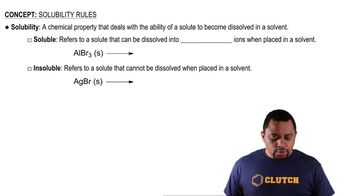
    Solubility is a chemical property describing the ability of a solute to dissolve in a solvent, forming a solution.
  • What happens to a soluble ionic compound when placed in water?

    A soluble ionic compound dissociates into its aqueous ions when placed in water.
  • What does it mean if a compound is insoluble?

    An insoluble compound does not dissolve in a solvent and does not break up into ions.
  • What is the purpose of solubility rules?

    Solubility rules help predict whether an ionic compound will be soluble or insoluble in water.
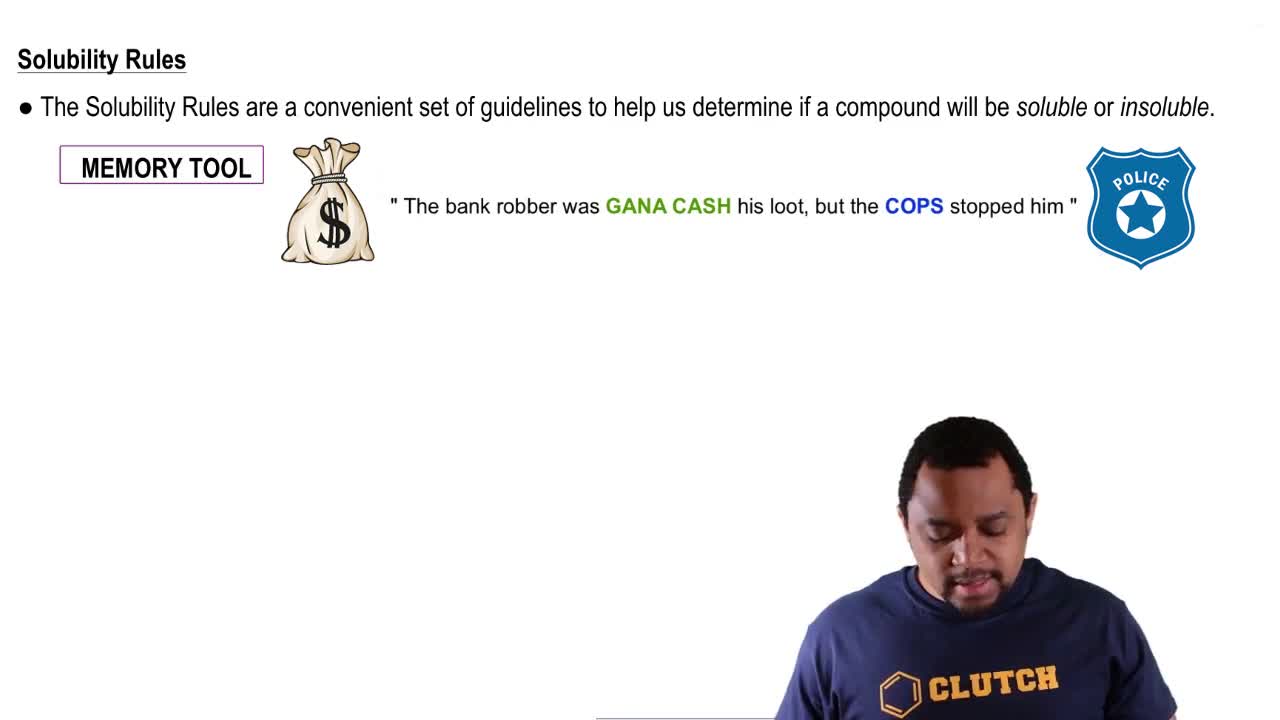
  • What does the mnemonic 'gonna cash' represent in solubility rules?

    'Gonna cash' represents the ions and compounds that are always soluble: Group 1A elements, acetate, nitrate, ammonium, chlorate, and perchlorate.
  • Which ions are always soluble with no exceptions according to 'gonna cash'?

    Group 1A elements, acetate, nitrate, ammonium, chlorate, and perchlorate ions are always soluble with no exceptions.
  • What are the exceptions for the solubility of sulfates?

    Sulfates are insoluble when paired with calcium, barium, strontium, mercury, silver, or lead.
  • When are halogens insoluble?

    Halogens are insoluble when combined with mercury, silver, or lead.
  • What does the mnemonic 'cops' represent in solubility rules?

    'Cops' stands for the generally insoluble ions: carbonates, chromates, oxides, hydroxides, phosphates, and sulfides.
  • What are the exceptions for the insolubility of oxides and hydroxides?

    Oxides and hydroxides become soluble when paired with calcium, barium, or strontium.
  • Which ions are exceptions to the insolubility of sulfides?

    Sulfides are soluble when combined with calcium, barium, or strontium.
  • What happens when a soluble compound meets an exception in the solubility rules?

    When a soluble compound meets an exception, it forms a precipitate, which is an insoluble solid.
  • What is a precipitate in the context of solubility?

    A precipitate is an insoluble solid that forms when certain ions combine in solution.
  • How do you determine if an ionic compound is soluble or insoluble?

    You use the solubility rules, including the 'gonna cash' and 'cops' mnemonics, and check for any exceptions.
  • What is the charge on the aluminum ion in aluminum bromide, and what happens to it in water?

    The aluminum ion in aluminum bromide has a 3+ charge and becomes an aqueous ion when dissolved in water.