Skip to main content
Microeconomics
My Course
Learn
Exam Prep
AI Tutor
Study Guides
Flashcards
Explore
Try the app
My Course
Learn
Exam Prep
AI Tutor
Study Guides
Flashcards
Explore
Try the app
Back
Long Run Equilibrium definitions
You can tap to flip the card.
Long Run Equilibrium
You can tap to flip the card.
👆
Long Run Equilibrium
Market condition where price equals minimum average total cost and firms earn zero economic profit after all adjustments.
Track progress
Control buttons has been changed to "navigation" mode.
1/15
Related flashcards
Related practice
Recommended videos
Long Run Equilibrium quiz #1
Long Run Equilibrium
9 Terms
Long Run Equilibrium
11. Perfect Competition
10 problems
Topic
Perfect Competition and Efficiency
11. Perfect Competition
10 problems
Topic
11. Perfect Competition
11 topics
15 problems
Chapter
Guided course
07:04
Long Run Equilibrium
2396
views
19
rank
1
comments
Terms in this set (15)
Hide definitions
Long Run Equilibrium
Market condition where price equals minimum average total cost and firms earn zero economic profit after all adjustments.
Average Total Cost
Total cost per unit of output, minimized in long run equilibrium, setting the benchmark for market price.
Economic Profit
Surplus earned when price exceeds average total cost, eliminated in the long run by market entry or exit.
Demand Curve
Graphical representation showing how quantity demanded changes with price, shifting right with increased demand.
Supply Curve
Graphical representation showing how quantity supplied changes with price, shifting right as new firms enter.
Marginal Cost
Additional cost incurred from producing one more unit, intersecting marginal revenue at optimal output.
Marginal Revenue
Additional revenue from selling one more unit, equal to price in perfect competition.
Perfect Competition
Market structure with many firms, identical products, and free entry, ensuring zero economic profit in the long run.
Short Run Equilibrium
Temporary market state where firms may earn profits or losses before entry or exit restores long run equilibrium.
Market Entry
Process where new firms join the industry, increasing supply and driving profits toward zero.
Market Exit
Process where firms leave the industry, reducing supply and eliminating losses.
Minimum ATC
Lowest point on the average total cost curve, setting the long run equilibrium price.
Quantity Supplied
Total amount of goods offered by firms at a given price, rising as demand and market entry increase.
Equilibrium Price
Market price where supply equals demand, returning to minimum average total cost after adjustments.
Zero Economic Profit
Outcome where total revenue equals total cost, achieved in the long run as market supply adjusts.
 BackBack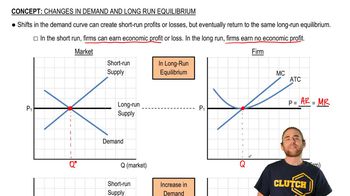
 07:04
07:04