Ch. 15 - Conjugated Systems, Orbital Symmetry, and Ultraviolet Spectroscopy
Wade - Organic Chemistry 9th Edition
Wade9th EditionOrganic ChemistryISBN: 9780135213728Not the one you use?Change textbook
Chapter 15, Problem 40g

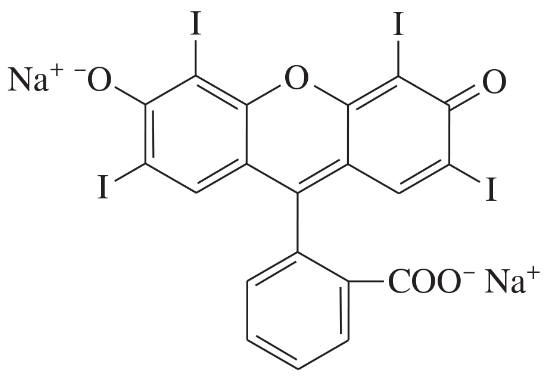
Determine whether each structure is likely to be colored or not. For those that you predict to be colored, indicate the extended conjugation by marking the series of continuous sp2 hybridized atoms.
(g)

Verified step by step guidance
1
Step 1: Analyze the structure for conjugation. Conjugation occurs when there is a series of alternating single and double bonds, allowing for delocalization of π-electrons across the molecule. In this structure, the aromatic rings and the double bonds in the fused ring system indicate extended conjugation.
Step 2: Identify the sp2 hybridized atoms. Look for atoms involved in double bonds or aromatic systems. In this molecule, the carbons in the aromatic rings and the fused ring system are sp2 hybridized, contributing to the conjugation.
Step 3: Determine if the molecule is likely to be colored. Molecules with extended conjugation often absorb visible light due to the delocalized π-electrons, which can result in coloration. The presence of iodine atoms may also influence the absorption spectrum.
Step 4: Mark the series of continuous sp2 hybridized atoms. Highlight the atoms in the aromatic rings and the fused ring system that are part of the conjugated system. This includes all carbons in the aromatic rings and the fused ring system, as well as any oxygen atoms involved in conjugation.
Step 5: Consider the functional groups. The presence of sodium salts (Na⁺) and iodine atoms does not disrupt the conjugation but may affect the molecule's solubility and electronic properties, further supporting the likelihood of the molecule being colored.

Verified video answer for a similar problem:

This video solution was recommended by our tutors as helpful for the problem above.
Video duration:
1m
Was this helpful?

Key Concepts

Here are the essential concepts you must grasp in order to answer the question correctly.

Conjugation

Conjugation refers to the overlap of p-orbitals across adjacent double bonds or lone pairs, allowing for delocalization of electrons. This delocalization stabilizes the molecule and can lead to color in organic compounds, as it lowers the energy gap between electronic states, allowing for visible light absorption.
Recommended video:
Guided course
03:27
Conjugated states

Extended Conjugation

Extended conjugation occurs when a system of alternating single and double bonds extends over a larger number of atoms, enhancing the delocalization of π-electrons. This phenomenon often results in compounds that can absorb light in the visible spectrum, contributing to their color. The more extensive the conjugation, the lower the energy required for electronic transitions.
Recommended video:
Guided course
03:27
Conjugated states

Color in Organic Compounds

The color of organic compounds is primarily due to their ability to absorb specific wavelengths of light, which is influenced by their electronic structure. Compounds with extensive conjugation typically absorb light in the ultraviolet or visible range, leading to the perception of color. The presence of functional groups, such as carboxylates or halogens, can also affect the color by altering the electronic properties of the conjugated system.
Recommended video:
Guided course
01:40
Defining meso compounds.
Related Practice
Textbook Question

Determine whether each structure is likely to be colored or not. For those that you predict to be colored, indicate the extended conjugation by marking the series of continuous sp2 hybridized atoms.

(a)

(b)

(c)

1180
views

Textbook Question

An important variation of the Diels–Alder reaction is intramolecular, in which the diene and the dienophile are connected. This type of Diels–Alder reaction makes two new rings. Draw the compound produced in each of these examples; try to predict stereochemistry (using models will help). In some cases, Lewis acid catalysts are used; that can be ignored for this problem.

(a)

(b)

971
views
Textbook Question

A student was studying terpene synthesis, and she wanted to make the compound shown here. First she converted 3-bromo-6-methylcyclohexene to alcohol A. She heated alcohol A with sulfuric acid and purified one of the components (compound B) from the resulting mixture. Compound B has the correct molecular formula for the desired product.

(c) Propose a mechanism for the dehydration of alcohol A to compound B.

1469
views
Textbook Question

Determine whether each structure is likely to be colored or not. For those that you predict to be colored, indicate the extended conjugation by marking the series of continuous sp2 hybridized atoms.

(i)

522
views
Textbook Question

Determine whether each structure is likely to be colored or not. For those that you predict to be colored, indicate the extended conjugation by marking the series of continuous sp2 hybridized atoms.

(h)

560
views
Textbook Question

Determine whether each structure is likely to be colored or not. For those that you predict to be colored, indicate the extended conjugation by marking the series of continuous sp2 hybridized atoms.

(d)

(e)

(f)

1283
views