Skip to main content
Personal Health
My Course
Learn
Exam Prep
AI Tutor
Study Guides
Flashcards
Try the app
My Course
Learn
Exam Prep
AI Tutor
Study Guides
Flashcards
Try the app
Back
Body Composition quiz
You can tap to flip the card.
What does body composition refer to?
You can tap to flip the card.
👆
What does body composition refer to?
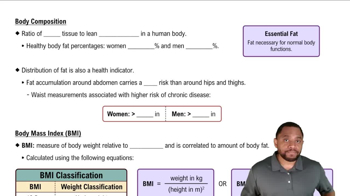
Body composition refers to the ratio of fat tissue to lean muscle in the human body.
Track progress
Control buttons has been changed to "navigation" mode.
1/20
Related flashcards
Related practice
Recommended videos
Body Composition definitions
Body Composition
15 Terms
Body Composition quiz #1
Body Composition
10 Terms
Body Composition
Ch.6 Weight Management
5 problems
Topic
Brendan
Factors Affecting Weight
Ch.6 Weight Management
5 problems
Topic
Ally
Ch.6 Weight Management - Part 1 of 2
5 topics
9 problems
Chapter
Laura
Ch.6 Weight Management - Part 2 of 2
1 topic
2 problems
Chapter
Laura
Guided course
1:18
Body Composition Example 1
74
views
3
rank
Guided course
4:44
Body Composition Concept 1
103
views
1
rank
Guided course
2:09
Clinical Methods Concept 2
78
views
2
rank
Terms in this set (20)
Hide definitions
What does body composition refer to?
Body composition refers to the ratio of fat tissue to lean muscle in the human body.
What is the healthy body fat percentage range for women?
The healthy body fat percentage range for women is about 15% to 32%.
What is the healthy body fat percentage range for men?
The healthy body fat percentage range for men is 8% to 24%.
Why are essential fats important for the body?
Essential fats are necessary for normal biological functions and overall health.
What can happen if body fat percentage is too low?
Having too low a body fat percentage can negatively impact overall health and biological functions.
Where is fat accumulation most risky for chronic diseases?
Fat accumulation around the abdomen increases the risk of chronic diseases more than fat around the hips and thighs.
What waist measurement increases chronic disease risk for women?
A waist measurement greater than 35 inches in women increases the risk for hypertension, diabetes, and cardiovascular disease.
What waist measurement increases chronic disease risk for men?
A waist measurement greater than 40 inches in men increases the risk for hypertension, diabetes, and cardiovascular disease.
Does having a large waist guarantee chronic disease?
No, a large waist increases risk but does not guarantee chronic disease.
What does BMI stand for?
BMI stands for Body Mass Index.
How is BMI calculated using pounds and inches?
BMI is calculated as weight in pounds divided by height in inches squared, then multiplied by 703.
What BMI range is considered underweight?
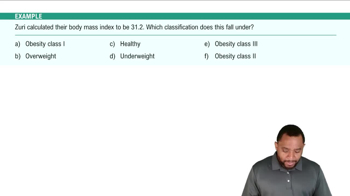
A BMI less than 18.5 is considered underweight.
What BMI range is considered healthy?
A BMI between 18.5 and 24.9 is considered healthy.
What BMI range is considered overweight?
A BMI between 25 and 29.9 is considered overweight.
What are the BMI ranges for obesity classes 1, 2, and 3?
Obesity 1 is 30-34.9, Obesity 2 is 35-39.9, and Obesity 3 is over 40.
What are some limitations of BMI?
BMI does not consider age, sex, or varying levels of muscle mass, which can distort results.
Why might a muscular person have a high BMI?
A muscular person may have a high BMI because muscle increases body weight, which can skew the BMI reading.
What is bioelectric impedance analysis (BIA)?
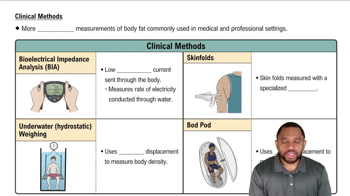
BIA is a clinical method that sends a low electrical current through the body to measure body fat based on water conduction.
How does underwater weighing determine body composition?
Underwater weighing uses water displacement to measure body density and determine fat to lean muscle ratio.
What is the Bod Pod and how does it work?
The Bod Pod is a clinical method that uses air displacement to measure body density and assess body composition.
 BackBack


 1:18
1:18