What is the definition of continuity at a point c for a function?
A function is continuous at c if the limit as x approaches c equals the function value at c.
How can you visually check continuity at a point on a graph?
You can trace through the function at the point without lifting your pen; if you don't have to stop, the function is continuous there.
What are the three main types of discontinuities seen in functions?
Discontinuities can occur as holes, jumps, or asymptotes.
Where do discontinuities commonly occur in rational functions?
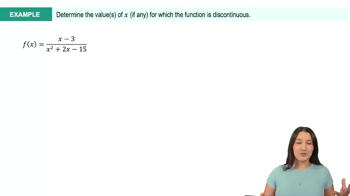
Discontinuities often occur where the denominator equals zero, which may indicate holes or asymptotes.
How do you determine continuity at a specific point using limits and function values?
Compare the limit as x approaches the point and the function value; if they are equal, the function is continuous at that point.
What happens if the limit as x approaches c does not exist for a function?
If the limit does not exist, the function is discontinuous at c.
What type of discontinuity occurs when the function value is undefined at a point but the limit exists?
This is called a hole or removable discontinuity.
How do you find where a rational function is discontinuous?
Set the denominator equal to zero and solve for x; these values are where the function is discontinuous.
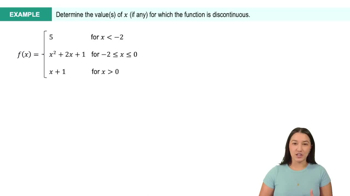
What is a jump discontinuity in a piecewise function?
A jump discontinuity occurs when the function 'jumps' from one value to another at the boundary between pieces, and the limits from each side are not equal.
How do you check for discontinuity at the boundary of a piecewise function?
Find the left and right-sided limits at the boundary and compare them to the function value; if they are not all equal, there is a discontinuity.
What is the function value and limit for f(x) at x = 2 if both are 4?
The function is continuous at x = 2 because the limit and function value are both 4.
What does it mean if you have to pick up your pen when tracing a graph at a point?
It means the function is discontinuous at that point.
What causes discontinuity at x = 4 in a piecewise function where left and right limits are not equal?
A jump discontinuity occurs because the limits from each side are different.
What is the discontinuity at x = 1 if the function approaches negative infinity from both sides?
There is an asymptote at x = 1, causing the function to be discontinuous there.
How do you determine if a piecewise function is continuous at the point where the pieces meet?
Check if the left and right-sided limits and the function value at the meeting point are all equal; if not, the function is discontinuous there.
 Back
Back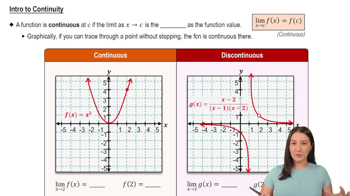
 05:34
05:34