Skip to main content
Precalculus
My Course
Learn
Exam Prep
AI Tutor
Study Guides
Flashcards
Explore
Try the app
My Course
Learn
Exam Prep
AI Tutor
Study Guides
Flashcards
Explore
Try the app
Back
Double Angle Identities quiz
You can tap to flip the card.
What is the double angle identity for sine?
You can tap to flip the card.
👆
What is the double angle identity for sine?
The double angle identity for sine is sin(2θ) = 2 sin(θ) cos(θ).
Track progress
Control buttons has been changed to "navigation" mode.
1/15
Related flashcards
Related practice
Recommended videos
Double Angle Identities definitions
Double Angle Identities
15 Terms
Double Angle Identities
12. Trigonometric Identities
4 problems
Topic
Solving Trigonometric Equations Using Identities
12. Trigonometric Identities
3 problems
Topic
12. Trigonometric Identities
4 topics
8 problems
Chapter
Guided course
5:06
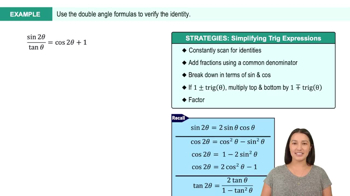
Double Angle Identities
1319
views
23
rank
Guided course
2:33
Double Angle Identities Example 1
908
views
27
rank
Guided course
2:26
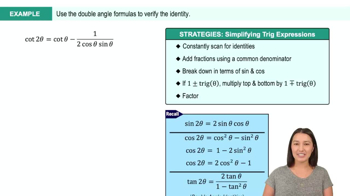
Double Angle Identities Example 2
774
views
22
rank
Terms in this set (15)
Hide definitions
What is the double angle identity for sine?
The double angle identity for sine is sin(2θ) = 2 sin(θ) cos(θ).
What is the double angle identity for cosine?
The double angle identity for cosine is cos(2θ) = cos²(θ) - sin²(θ).
What is the double angle identity for tangent?
The double angle identity for tangent is tan(2θ) = 2 tan(θ) / (1 - tan²(θ)).
How are double angle identities derived?
They are derived from the sum formulas by using the same angle for both terms.
How can cos²(π/12) - sin²(π/12) be simplified using a double angle identity?
It can be rewritten as cos(2 × π/12) = cos(π/6).
What is the value of cos(π/6)?
The value of cos(π/6) is √3/2.
How can sin(15°) cos(15°) be rewritten using a double angle identity?
It can be rewritten as sin(30°)/2 using the sine double angle identity.
What should you look for when deciding to use a double angle identity?
Look for expressions that match or contain parts of the double angle identities.
What is an alternate form of the cosine double angle identity using only cosine?
cos(2θ) = 2 cos²(θ) - 1.
What is an alternate form of the cosine double angle identity using only sine?
cos(2θ) = 1 - 2 sin²(θ).
If you see an argument of 2θ in a trig expression, what identity should you consider using?
You should consider using the double angle identities.
How can you express sin(θ) cos(θ) in terms of sin(2θ)?
sin(θ) cos(θ) = sin(2θ)/2.
Why are double angle identities useful in trigonometry?
They help simplify trig expressions and make it easier to solve problems.
What is the process for simplifying an expression like sin(15°) cos(15°) using identities?
Recognize it as part of the sine double angle identity and rewrite it as sin(30°)/2.
What is the general strategy for simplifying trig expressions with identities?
Scan for patterns that match known identities and rewrite the expression using those identities.
 BackBack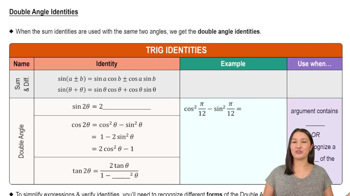
 5:06
5:06