Skip to main content
Precalculus
My Course
Learn
Exam Prep
AI Tutor
Study Guides
Flashcards
Explore
Try the app
My Course
Learn
Exam Prep
AI Tutor
Study Guides
Flashcards
Explore
Try the app
Back
Exponents quiz
You can tap to flip the card.
What does 1 raised to any power equal?
You can tap to flip the card.
👆
What does 1 raised to any power equal?
1 raised to any power always equals 1, regardless of the exponent.
Track progress
Control buttons has been changed to "navigation" mode.
1/15
Related flashcards
Related practice
Recommended videos
Exponents definitions
Exponents
15 Terms
Exponents
0. Fundamental Concepts of Algebra
3 problems
Topic
Polynomials Intro
0. Fundamental Concepts of Algebra
3 problems
Topic
0. Fundamental Concepts of Algebra
10 topics
10 problems
Chapter
6:37
Zero and Negative Rules
2231
views
99
rank
5:50
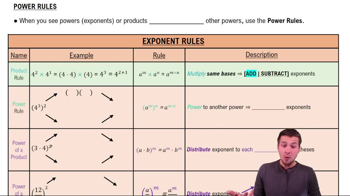
Power Rules
1990
views
77
rank
6:39
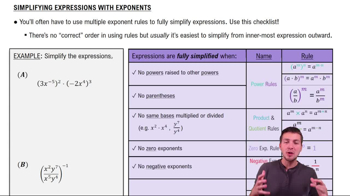
Simplifying Exponential Expressions
1738
views
117
rank
2
comments
Terms in this set (15)
Hide definitions
What does 1 raised to any power equal?
1 raised to any power always equals 1, regardless of the exponent.
What happens to the negative sign when a negative number is raised to an even power?
The negative sign cancels out, so the result is positive.
What is the result of a negative number raised to an odd power?
The result keeps the negative sign, so the answer is negative.
What is the product rule for exponents when multiplying terms with the same base?
You add the exponents together when multiplying terms with the same base.
What is the quotient rule for exponents when dividing terms with the same base?
You subtract the exponent in the denominator from the exponent in the numerator.
What does any nonzero number raised to the zero power equal?
Any nonzero number raised to the zero power equals 1.
What does a negative exponent indicate?
A negative exponent means you take the reciprocal of the base raised to the positive exponent.
How do you simplify (xy)^-3?
You rewrite it as 1 divided by (xy)^3.
How do you simplify x*y^-3 (without parentheses)?
You rewrite it as x divided by y^3.
What is the power rule for exponents when you have a power raised to another power?
You multiply the exponents together.
How do you simplify (ab)^n using exponent rules?
You distribute the exponent: (ab)^n = a^n * b^n.
How do you simplify (a/b)^n using exponent rules?
You distribute the exponent: (a/b)^n = a^n / b^n.
What should you do if you have negative exponents in your final answer?
Rewrite the expression so all exponents are positive by moving terms with negative exponents to the opposite side of the fraction.
What is a systematic approach to simplifying complex exponent expressions?
Check for powers on powers, combine like bases, evaluate numbers, and ensure no negative or zero exponents remain.
When simplifying expressions with multiple exponent rules, what order is usually best?
It's usually best to simplify inside parentheses first and then work outward.
 BackBack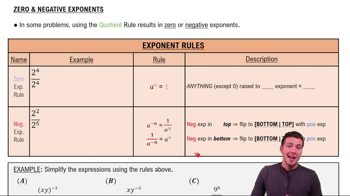
 6:37
6:37